
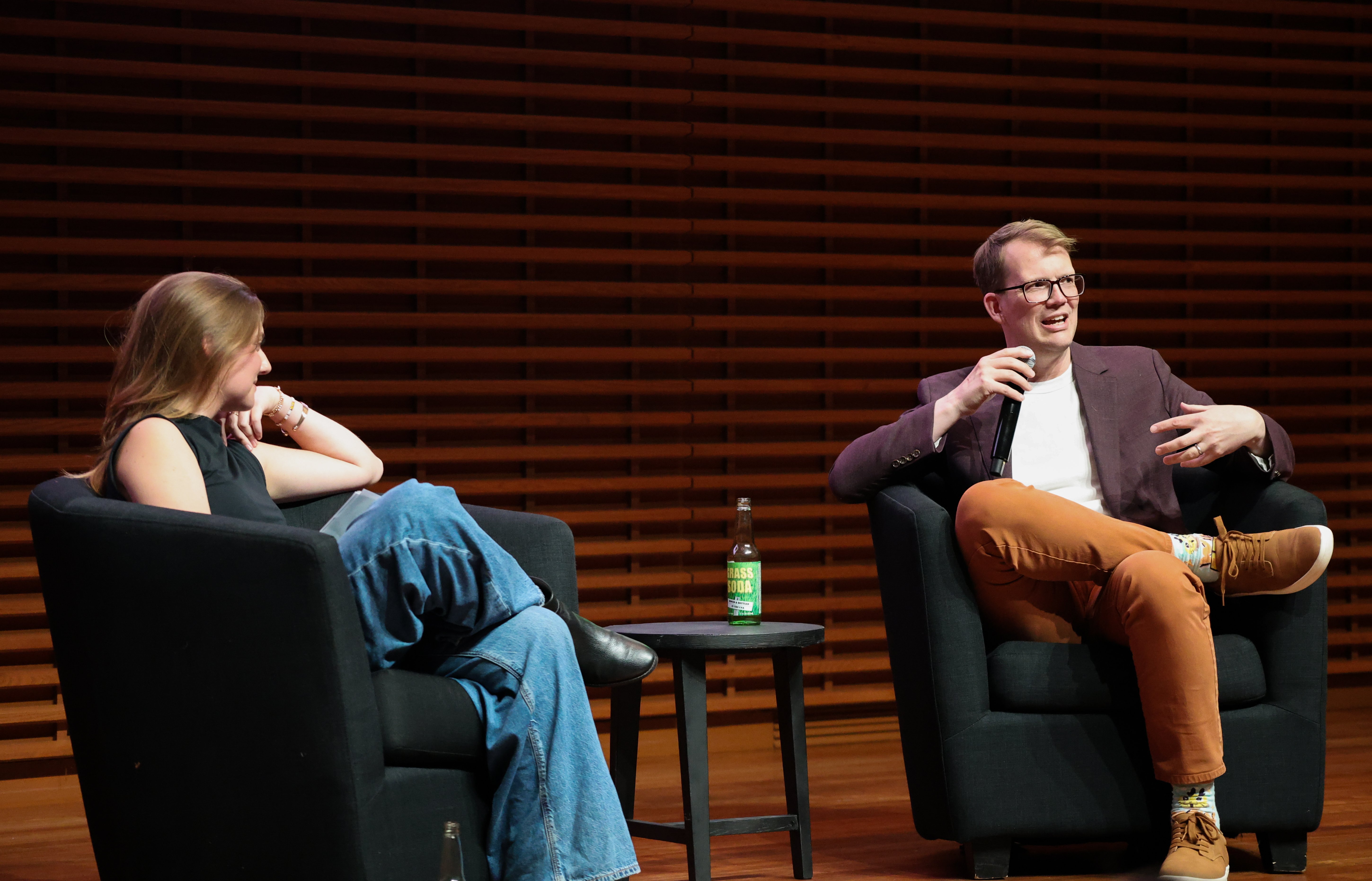
Hank Green addressed the rewards and challenges of social impact entrepreneurship, attention in a world of algorithms and having a famous brother in a sold-out talk at CEMEX Auditorium Friday, marking Stanford Speakers Bureau’s (SSB) last event of the year.
Molly Maloney ’28 interviewed Green, an internet personality, New York Times best-selling author, science communicator and social impact entrepreneur, on everything from his greatest achievements to what his favorite fact is.
Tickets for the event sold out ten minutes after they were announced last Wednesday, and hundreds waited outside in the standby line on Friday in an attempt to get tickets. Though Green was not able to meet all his fans personally, one got to go behind the scenes as a prize for winning a trivia Kahoot on Green and his work.
Throughout the discussion, Green and Maloney focused on attention and information distribution and quality in the age of the internet. “What does it mean to be good content on an imperfect, or dare I say bad, algorithm or platform?” Maloney asked Green.
Green compared the relationship between content and algorithm to that between food and food systems. There’s bad food, Green said, and then there’s bad food systems. “Imagine how we would feel if there was a man with a pepperoni pizza who lived in our pockets and would always give you however much pepperoni pizza you wanted, and you never got full,” said Green, comparing the man living in our pockets to phones.
However, Green also said people shouldn’t blame themselves for failing to moderate their internet use, as everyone has little experience with it. “It’s like if cocaine didn’t exist,” said Green. “And then one day it showed up in the water and we’re like, wow, I feel pretty good.”
Throughout the night, Maloney and Green bantered back and forth about Green’s working relationship with his brother, John Green, also a New York Times bestselling author and internet personality. “What’s your biggest achievement other than being John Green’s brother?” Maloney joked, receiving “oohs” from the audience. Maloney asked what it was like to have such a “tight working relationship” with a sibling.
“John makes me into a better person, and I think I probably make him into a better person,” said Green.
Though Maloney knew a bit about Green as a fan before interviewing him, she only had about an hour to build a rapport prior to heading out onstage. “I definitely made fun of him a little bit,” Maloney said, noting that she had gotten permission from Green to do so ahead of time.
“Backstage, [Green] was like, ‘When people are mean to me it’s great, it’s a little bit funny,’” said Maloney. According to Maloney, the two chatted about “weird experiences with billionaires and weird handshakes” before bringing the vibe onstage to an audience of over 500 at CEMEX.
Despite CEMEX’s large capacity, over 300 students remained outside for over an hour, hoping to get stand-by tickets to get inside for the talk. SSB co-president Anish Anne ’28 said he felt frustrated that not all students interested were able to attend.
“It’s so frustrating because [over 300] people waited [outside] for over an hour. They really wanted to see Hank Green,” said Anne. Only 20 of the students waiting in line gained entry to the event, according to Anne.
The talk was hosted at Stanford Graduate School of Business’s CEMEX Auditorium, which has a capacity of 587 seats. Memorial Auditorium, a larger venue, would have allowed just over 1,700 students to attend the talk. However, another performance was already scheduled in Pigott Theater, which is attached to Memorial Auditorium.
TAPS has told SSB in the past that events cannot be hosted at Memorial Auditorium and Pigott Theater in the same night, even if they do not overlap with each other, explained Anne. If TAPS has a performance in Pigott or MemAud, Anne said, both spaces are reserved for the entire day and the week leading up to the show.
Since there was an event scheduled for the evening of Green’s talk in Pigott, SSB did not reach out to request the auditorium.
Memorial Auditorium is also significantly more expensive than CEMEX, costing around $15,000 due to costs from various vendors, said Anne. This compares to a cost of around $2,500 to host an event in CEMEX, according to Anne.
“Budget aside, I would have been happy to pay an extra 5 or $10,000 if I could have seated the 300 people outside in a waitlist line,” Anne said.
Despite these frustrations, both Anne and Maloney said they were proud of the messages that Green brought to campus. “I think he’s definitely a model on a way to do good in your career and your personal life,” said Maloney.
“The most impactful thing he talked about is how you can be an entrepreneur and change the world, but do it in a good way,” said Anne. “He talked a lot about values, his values, and how he came to that point of having values. I think that’s a very good message to bring to the student body.”