
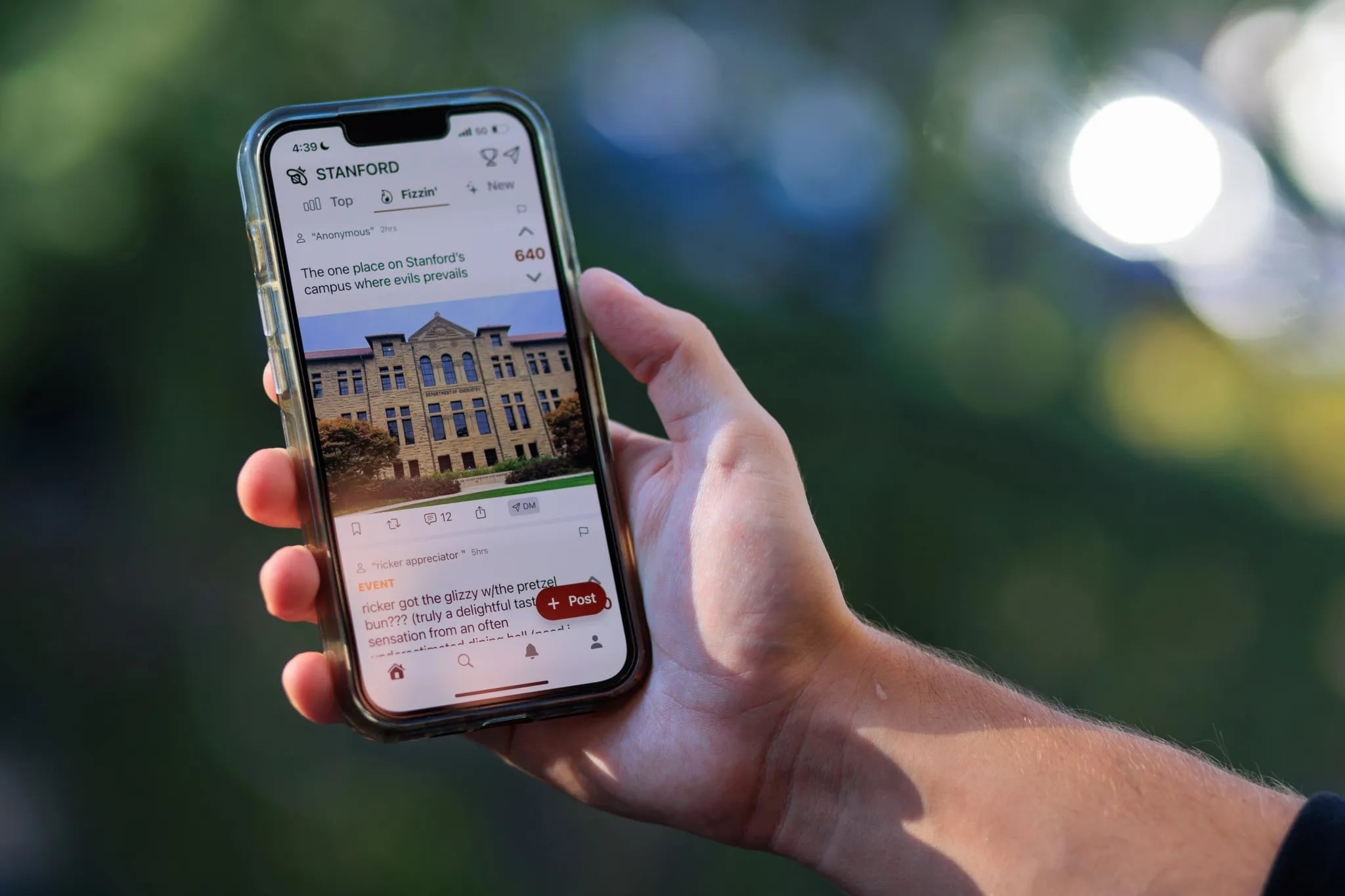
Sophomore year I found myself scrolling through social media during lunch, dinner, really anytime I had a free moment away from work. I remember defending myself to a friend. It is good to know what is Fizzin’. It is good to know what is on the ’gram. It was denial, really. I could no longer justify the hours lost to brainrot.
This fall, I deleted Instagram and axed my YouTube history so its algorithms no longer recommend content. I started to notice the effects. Interactions felt intentional. Work felt productive and exciting.
Yet several popular social media platforms are connected to Stanford. “This is where things began. Snapchat was founded at Stanford. Instagram’s founders met at Stanford,” Truitt Flink ’28 told The Daily. Flink is co-founder of Reconnect Stanford, a student-led movement helping people through “social media sobriety.”
Fizz, an anonymous messaging app used by Stanford students, also holds strong ties to campus. “In the Fall of 2020, we were freshmen at Stanford University and noticed a lack of connection and authenticity on a campus grappling with Covid restrictions. There was no centralized platform… We thus set out to create Fizz, a private campus-specific platform that facilitates authentic conversations,” the app’s founding story explains.
It is a cute story that follows the tried and true recipe of noticing a social problem and “solving” it with a social platform. It’s strange, then, that using social media sucked me away from the very interaction it promised to help me find. And from the looks of it, I’m not the only one who feels this way. “I felt like I started to live more for those curated moments than the real thing,” Flink said. “A lot of my experiences felt dulled beneath the veil of needing to post them,” Reconnect Stanford Financial Officer Mahalia Morgan ’27 echoed.
Reconnect Stanford founding member Samin Bhan ’28 took care to clarify that Reconnect Stanford does not place blame on any particular individual or platform. Instead, the group focuses on the experience of real people. “We want to think about it at a systems level. We are not anti a particular person or company. We are expressing what’s happening on the ground,” Bhan said.
Observation
To better understand how Stanford undergraduates use social media, The Daily distributed a survey to a random sample of 500 students. We collected 35 responses. The average respondent spends 3.22 hours on social media each day and rates their relationship with social media as 2.7 out of 5, or just under neutral. Respondents associated social media use with the words “doomscroll,” “brainrot” and “comparison.” And yet if we cross tabulate Relationship and Hours we find that students who spend more time on social media have a poorer relationship with it.
It is strange that students recognize that their relationship with social media is poor yet find themselves spending several hours on social media platforms. Flink offered some insight into the paradox. “People know that they don’t feel good. They know that it harms their relationships and their mental health — and yet they can’t pull away from it,” she said. “The problem is not a lack of willpower. The problem is that there’s not scaffolding in place to support that.”
Of course, we use different platforms for different reasons. The top platforms respondents reported using are Instagram, LinkedIn and YouTube. The platforms typically cover two different reasons for use. For example, respondents reported using Instagram for “connection” and “entertainment” but not as a source of information. On the other hand, respondents reported using LinkedIn for “connection” and occasionally “information” but never for “entertainment.”
The responses align fairly well with the overall popularity of social media platforms in the U.S. The notable exception is LinkedIn, which saw stronger popularity at Stanford than across the U.S. population. It can remind us, Bhan explained, that Stanford students are not so different from any other students. “We’re no different than any other kid. Being at Stanford doesn’t mean we’re less susceptible to the purposeful engineering and tactics companies use,” he said.
Respondents reported most frequently using social media during activities that involve down time. These included relaxing, eating and waiting. Conversely, activities involving focus did not see a lot of social media use.
Interpretation
Despite strong opinions and “common” knowledge, it is hard to write off social media as bad. Instead, the effects are very much an open research agenda, according to Sunny Xu, the director of the Stanford Social Media Lab, which focuses on understanding social technologies.
“We don’t really have strong causal evidence suggesting that social media will drive mental health or well-being outcomes,” Xu said. “There’s a lot of gaps — between evidence and public perceptions, and also in methodologies.”
We find social media draining and distracting. It keeps us from being ourselves. And yet many of us find genuine value in social media as well. It is hard to characterize our consumption in normative terms. The truth likely lives somewhere between good and bad. Research will deepen our understanding of these technologies, but in the meantime, what’s most clear is that, to live with social media, we need balance.