
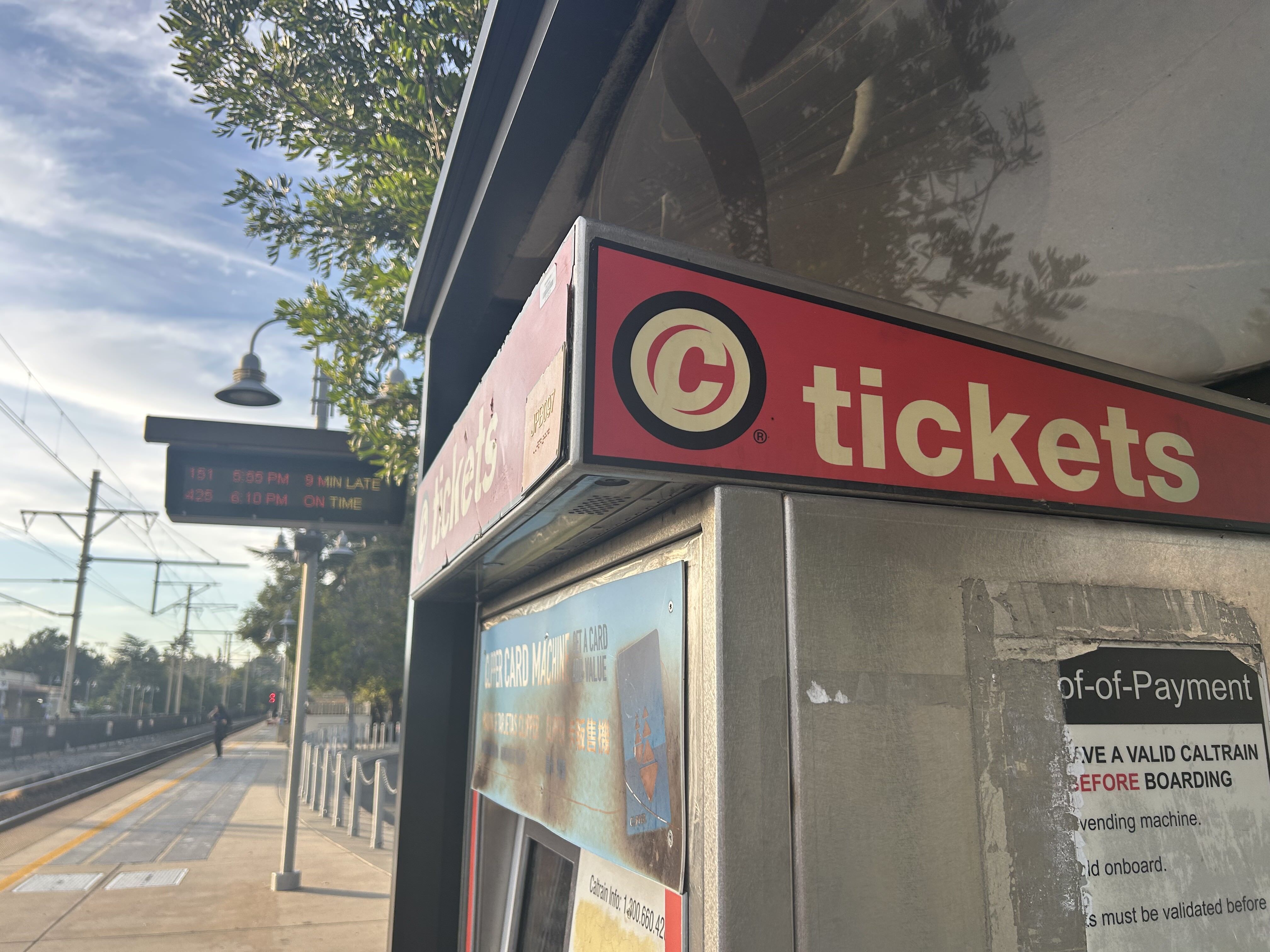
It’s Friday rush hour at the Palo Alto Caltrain station, and the 5:25 p.m. is running late.
People heading home from work and school stand with bikes and scooters on the crowded northbound platform. The train pulls in at 5:50 p.m., 25 minutes behind schedule.
“Usually, it’s been good,” Caltrain rider Megan Mayerle said of on-time service. “The last couple months have been really bad, and I do not know what’s going on.”
Mayerle, who works at the Beckman Center for Molecular and Genetic Medicine in Stanford Medicine, was on her way home to San Francisco. She takes the Bay Area Rapid Transit (BART) and Caltrain about five days a week.
Soon, Mayerle will be able to weigh in on whether to fund the transit options she relies on. On Nov. 3, Bay Area residents will vote on Senate Bill 63, a local revenue measure for public transit funding. Also known as the Connect Bay Area Act, the bill would raise taxes to fund transit agencies like Caltrain, BART, San Francisco Municipal Transportation Agency (Muni) and Alameda-Contra Costa Transit (ACT).
SB 63 would establish a Public Transit Revenue Measure District — a special jurisdiction for a tax — in the counties of Alameda, Contra Costa, San Mateo, Santa Clara and the City and County of San Francisco. The bill would raise the sales and use tax — on the sale, storage and use of retail goods — by 0.5% in these counties and 1% in San Francisco. Sales tax is collected by retailers at the point of sale, while use tax keeps buyers from avoiding taxes by purchasing goods online or from out-of-state sellers.
If approved, the proceeds would be allocated to specified transit agencies for 14 years.
“Regional funding, increased coordination, financial efficiency, and safety, cleanliness and reliability reforms are urgently needed to both preserve and improve public transit service,” the bill states.
The Bay Area Council, a business and civic leadership non-profit organization, gathered signatures last year to place the measure on the ballot and is campaigning for its passage next month.
SB 63 will ensure transit systems avoid service cuts and continue providing frequent, convenient service, according to council President and Chief Executive Officer (CEO) Libby Schaaf.
“Transit not only helps students, workers and seniors, many of whom don’t own cars, by providing affordable and essential transportation, it also supports a healthy economy that ensures job opportunities,” Schaaf wrote.
She added that public transit reduces carbon emissions from automobiles that reduce air quality and contribute to climate change.
“A yes vote for the Regional Transit Measure [RTM] is a vote for strong mobility options, a strong economy and a healthy environment,” Schaaf wrote.
San Mateo resident Marlen Gutierrez works in Stanford’s Office of Accessible Education as the Student Registration Coordinator. She recently started taking the Caltrain to work instead of driving, citing gas prices.
“Tt’s better to be able to unwind on my way home too and not be stuck in traffic,” Gutierrez added. “So far the times have been pretty reliable.”
But not everybody is on board with the measure. The Committee for Affordable Bay Area Transit (CABAT) opposes the RTM, criticizing the tax’s impact on working families and calling for a wider reform of the Bay Area’s transportation systems.
“The broader issue concerns the cost, governance and service provided by the current transit establishment, which we believe is incompetent, corrupt and massively costly/wasteful,” president Gregg Dieguez wrote in a statement to The Daily.
CABAT is not calling for the elimination of Caltrain or BART services, Dieguez said. Rather, they want transit agencies to manage costs and labor and cut down top-heavy administration before raising taxes.
“Unfortunately, many voters will treat the RTM vote as a simple choice between another regressive sales tax and ‘Carmageddon,’” Dieguez wrote. “In reality, the issue is ‘What type of transportation best fits our needs, what should it cost and who can be trusted to operate it?’”
Mayerle and other passengers waiting for the train on Friday were unaware of the upcoming vote on RTM.
“I would be for it without having read it,” Mayerle said. “Seems like we have to pass one of these every three years, though, so I’m not quite sure why they can’t use any money to improve anything.”