
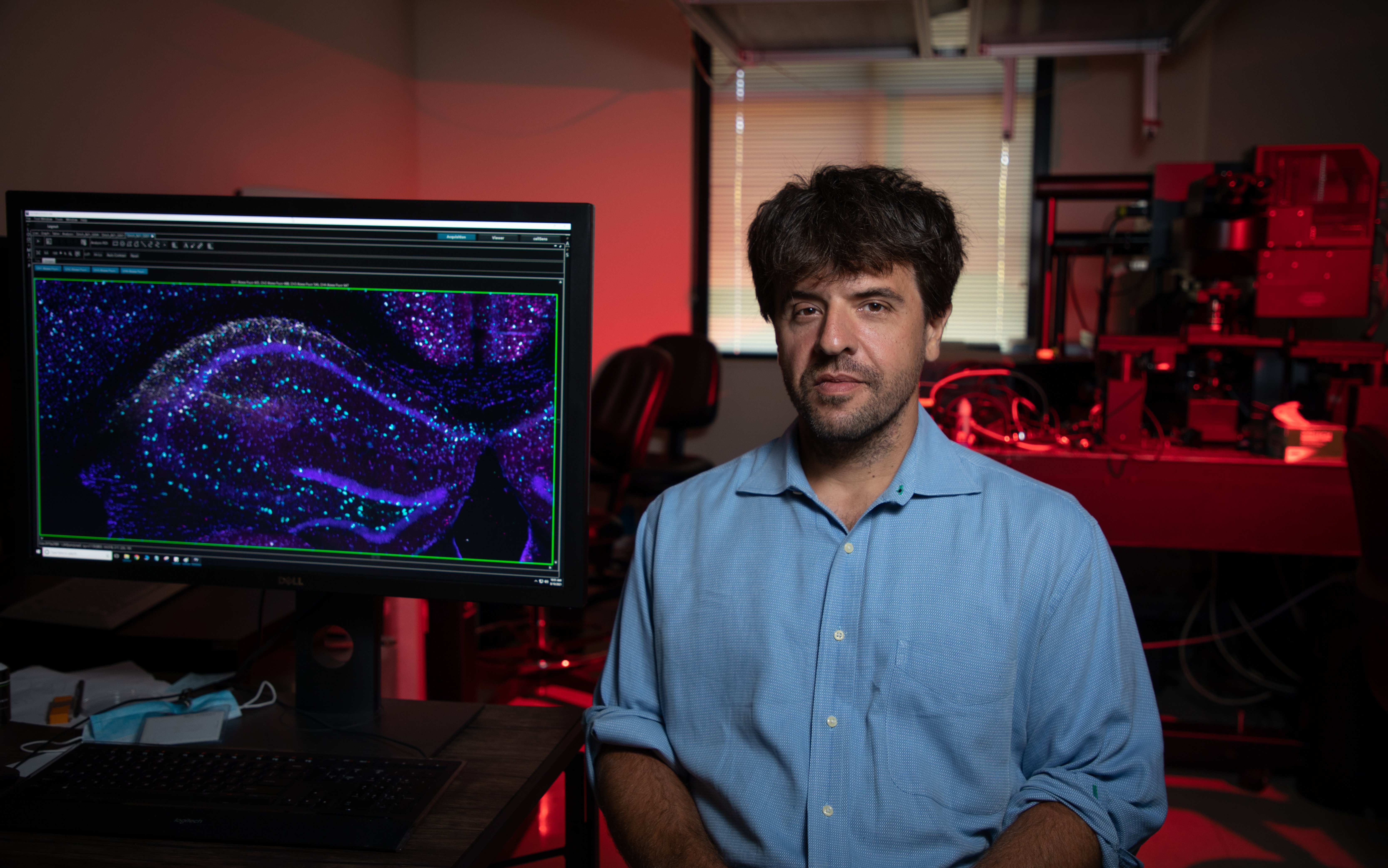
Even after receiving the 2026 Nobel Prize in Physiology or Medicine, Stanford neuroscientist Deisseroth said the questions driving his research remain the same. He wants to understand how the brain’s billions of cells coordinate their activity and combine information to produce emotions, thoughts and mental states.
“We still don’t know how that’s possible,” Deisseroth said in an interview with The Daily.
For Deisseroth, understanding the brain requires more than identifying its individual components. Scientists must also understand how those components work together to produce a unified experience.
“We know the parts, the components, the parts list,” he said. Researchers have made significant progress identifying different cell types and determining where they are located in the brain. They are also beginning to understand how those cells are connected. But Deisseroth said what remains missing is “a more active view of the brain.”
That means investigating how information moves between brain regions and how feelings, contextual knowledge and priorities come together in a given moment. Deisseroth said he wants to identify the principles that govern this flow of activity and explain how separate components integrate into a unified experience.
The question is not simply what the brain is made of but how it works.
Deisseroth’s Nobel-winning work helped make it possible for researchers to investigate these questions in new ways. His research in optogenetics, a technique that uses light-sensitive proteins called opsins to control the activity of specific neurons, allows scientists to investigate how brain circuits function. By enabling researchers to manipulate selected brain cells, the technique offers a way to investigate how neural activity contributes to behavior and mental states.
Laura Roberts, chair of Stanford’s Department of Psychiatry and Behavioral Sciences, told The Stanford Report that Deisseroth’s work has helped scientists investigate how individual neurons contribute to brain and emotional states.
“Karl’s work allows us to see the role of individual neurons and types of neurons in giving rise to specific brain, behavioral and emotional states,” Roberts said.
But Deisseroth’s breakthrough was far from guaranteed.
“I was turned down for funding by a lot of people who thought this couldn’t possibly work,” Deisseroth told The Stanford Report. Researchers had known about opsins for decades, but using them to control neuronal activity presented significant technical challenges. Deisseroth’s team eventually developed methods to deliver opsin-encoding genes to nervous tissue and target specific types of neurons, helping establish optogenetics as a tool for neuroscience.
His work continues to raise questions about how the brain and body influence one another. Deisseroth’s research with mice in 2007, for example, challenged the assumption that an increased heart rate is a consequence of anxiety.
People used to think that “if you have a faster beating heart, that’ll make you more anxious,” he said.
But the relationship, he explained, depends on context. A faster heartbeat alone does not necessarily produce anxiety. In a situation that is already anxiety-provoking, however, it can intensify the response.
The finding prompted further questions about how signals from the body shape emotional experiences. Deisseroth wondered whether other bodily sensations might also influence how people feel, including the sensation of goosebumps when someone is frightened or unsettled. He said researchers could investigate whether inducing that physical response changes a person’s internal emotional state or whether goosebumps reflect an emotion already being experienced.
For Deisseroth, these unanswered questions are part of what makes scientific research worth pursuing.
“Some problems are just beautiful in their own right,” he said.
That beauty, he explained, can sustain researchers through difficult problems that take years to solve. His work as a psychiatrist provides another source of motivation. Treating patients with neuropsychiatric disorders motivates him to help people who are suffering.
Stanford professor of neurology Michelle Monje has described Deisseroth’s research as a step toward understanding human cognition and emotions while addressing psychiatric disease. “Now he’s able to take the next step and really study circuit-level aspects of human cognition and emotions all with the goal of healing and comforting,” Monje told Stanford Medicine in 2023.
Understanding that inner world remains a challenge partly because the brain is constantly changing. Its cells interact, respond to information and coordinate activity across different regions. Identifying individual neurons and their connections does not necessarily explain how these interactions produce a particular thought, feeling or mental state.
Computational modeling and artificial intelligence (AI) could help researchers address that challenge. Deisseroth said advances in computational, statistical and AI-based methods have made it possible not only to manage large streams of complex data, but also to identify broader concepts within them.
He expects these methods to become a crucial part of neuroscience’s future. Rather than simply cataloging the brain’s components, researchers may increasingly be able to investigate the principles that govern how those components interact.
For Deisseroth, the Nobel Prize has provided renewed energy for his team and an opportunity to communicate the importance of fundamental scientific research to the public. The questions driving his work have not changed, but the award could make it easier to share the scientific process behind his discoveries, he said.
Breakthroughs emerge from basic scientific exploration, even when researchers cannot predict their eventual applications, he told The Daily.
The questions that remain are substantial: How does the brain keep its activity coordinated across billions of cells? How do information, context and emotion come together to create a unified experience? And how can understanding those processes improve the treatment of psychiatric disorders?
Deisseroth does not yet have answers to all of them, but for a scientist who finds beauty in complex problems, uncertainty is part of the appeal.