
Content warning: This article discusses sexual assault and harassment.
For the past six years, Stanford’s Title IX and Title VI Office has organized the annual Take Back the Night (TBTN) rally against sexual violence. On Sunday, students voiced their criticism of the University’s sexual assault policies as they were left to run the event by themselves.
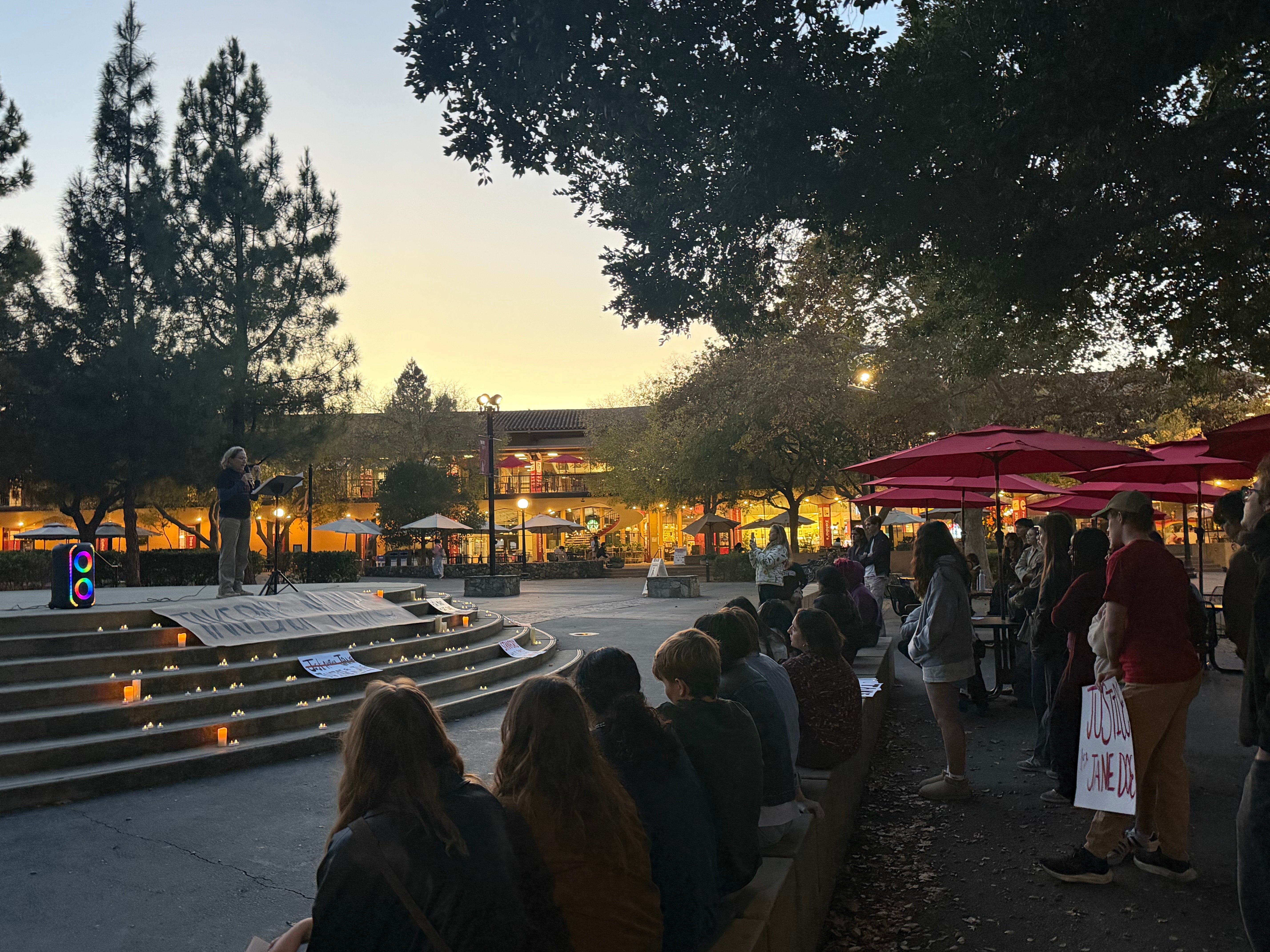
Students gathered in White Plaza to listen to speeches before marching through campus silently to the Chanel Miller Contemplative Garden. Speakers criticized the Title IX and Title VI Office for rolling back sexual violence prevention programs and faulted the University for the delayed processing of a Title IX case referenced in a recent Daily op-ed.
“The fact that it took Stanford two years to follow through on the Stanford Jane Doe investigation is not okay,” event organizer Nini Khanna ’28 said about the delayed Title IX case in an interview with The Daily. “The systems in place to help survivors need to be better, and they need to hold perpetrators more accountable.”
The rally is part of a national event that traditionally takes place in April. It was moved to Nov. 1 this year due to renewed conversation around sexual assault following the Cornell Seven lawsuit and recent changes to Title IX rules that narrowed the definition of what constitutes sexual harassment.
This year’s event was the first at Stanford to be fully student-led. Resisting Rape Culture at Stanford (RRCUS), which students founded in response to the Cornell Seven lawsuit earlier this year, was the primary organizer of this year’s rally.
“It’s disappointing that it has to be done by students,” said Pelagia Martin ’27, an organizer and former employee at the Title IX and Title VI Office. “There should be adults and trained professionals in our corner to protect us.”
“The importance of it being hosted by an office is that it’s permanent,” Martin said of the event’s previous institutional backing.
During the event, Stanford students called on the University to adopt policy changes outlined in The National Student Mandate to End Campus Rape Culture, a campaign syndicated between event organizers by Take Back the Night. Attendees’ demands included better prevention education, increased transparency of campus sexual violence and more accessible reporting options.
“Institutions like Stanford make us feel like there’s nothing we can do. They make us feel helpless,” said RRCUS member Addie Rahmlow ’28. “It is up to us to push for a future where sexual assault is not a part of the collective college experience.”
The Daily has reached out to the University as well as the Title IX and Title VI Office for comment.
Speakers highlighted the reinstatement of Flip the Script, a sexual violence education program that the University briefly eliminated earlier this quarter. Stanford Law School emerita professor Michele Dauber endorsed Flip the Script during the event as key to preventing sexual assault, encouraging all female-identifying students present to enroll in the program.
“No matter how good the response is, it’s always better to prevent the assault from happening in the first place,” Dauber said. “Even if a student has already experienced an assault, [Flip the Script] can protect them from further harm.”
Flip the Script is based on a sexual assault resistance program tested at three Canadian universities. Research from the New England Journal of Medicine found that the program significantly reduced the rate of campus sexual assault. Dauber emphasized the importance of Flip the Script given Stanford’s undergraduate female sexual assault rate of 32% in 2024.
Speakers said that they hope the rally will call the University’s and the student body’s attention to sexual violence on campus. “We want to make a cultural shift within the student body and create more of an ethic of upstanding, speaking out,” Khanna said. “Fraternity culture breeds an environment where rape culture thrives because there’s a lack of upstander attitudes, and I don’t think that’s just restricted to fraternities.”
“I hope that the University sees that students are not okay with what they’re doing. We’re not gonna be complacent in this,” Martin said.
“And I hope that students know that there is a community of survivors on campus that are here to support them, and that if the University isn’t going to support us, we’ll support each other.”
Students may speak to a counselor at the 24/7 Confidential Support Team at (650) 725-9955 to speak about their options if they feel unsafe or have experienced sexual assault. Students may also fill out a Title IX Reporting Form and may choose from there what steps they want to pursue. Students have access to supportive resources even if they do not wish to pursue an investigation. Visit https://share.stanford.edu/get-help for information on resources for sexual harassment, sexual violence and relationship violence.