
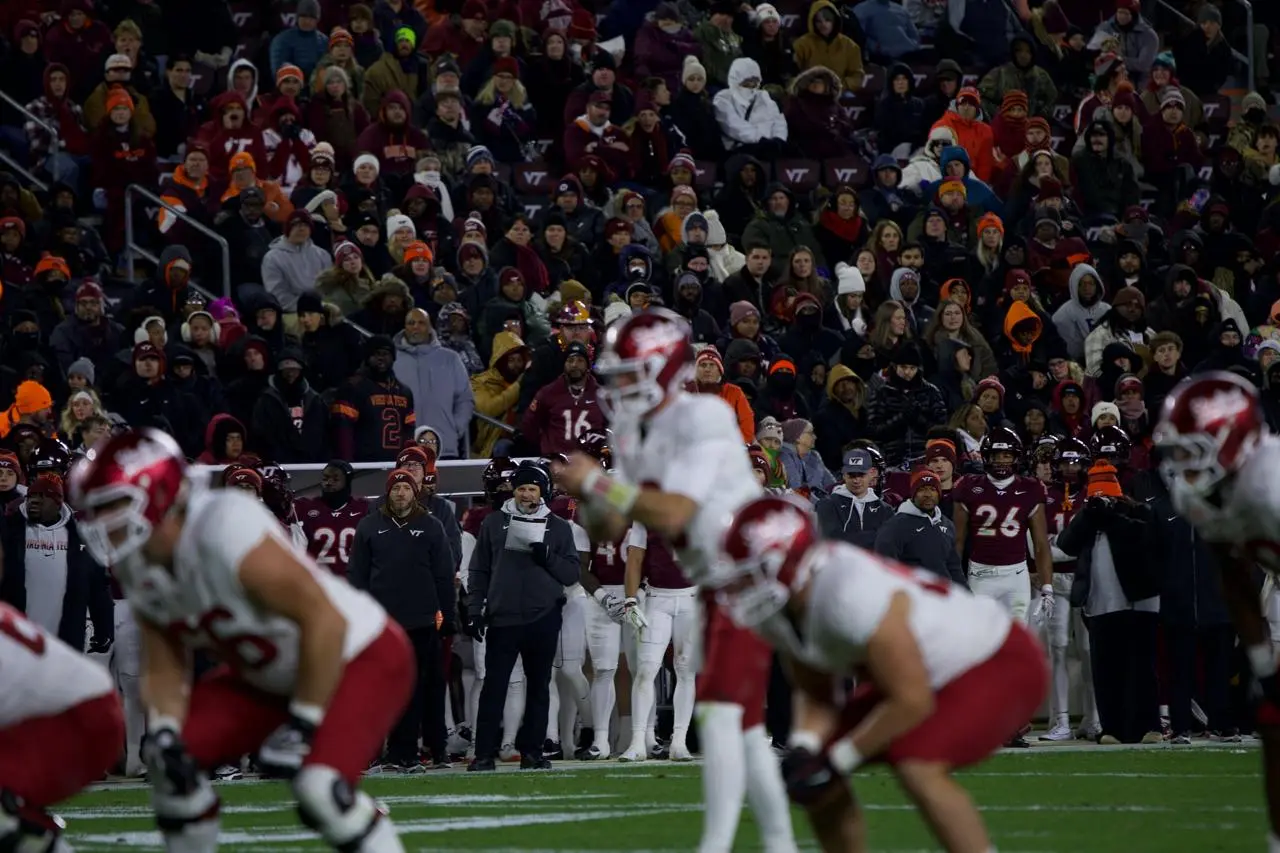
Last weekend, the Stanford Cardinal (5-5, 3-4 ACC) made their final cross-country trip of the season to take on the Virginia Tech Hokies (6-4, 3-4 ACC) in front of a sellout crowd at Lane Stadium. The nighttime air and freezing wind in Blacksburg, Virginia, bit straight through the gloves and four layers of clothing I had worn in anticipation of the cold Appalachian weather. Still, Hokie fans showed up in droves for game day, packing the stadium well before kickoff.
“Enter Sandman,” Virginia Tech’s walkout song and one of college football’s most iconic traditions, was deafening from the sideline, with more than 65,000 fans roaring in unison. By comparison, Stanford Stadium is routinely a ghost town, jokingly dubbed “The Library” for its noiselessness. With Cardinal supporters having trouble assembling a half-full crowd at Stanford Stadium, often dipping below quarter-full, it raises the question: What’s wrong with Stanford fans?
To get a better sense of the differences in the Stanford and Virginia Tech home crowds, I interviewed students on both campuses. Unfortunately, it’s fair to say that Stanford’s fan base looks a little grim.
“I don’t usually go to football games because I don’t have the time,” remarked Grady Fleming ’29, “and I don’t have the time to do many things other than study at this point.”
This sentiment is well-taken. Stanford students are well-acquainted with the need to pack their schedules to the brim while appearing completely at ease to others. Students are expected to volunteer, conduct research and take on internships on top of upwards of 50 hours a week of coursework. For years, duck syndrome and a brutal, unbalanced academic culture have caused Cardinal football to slowly hemorrhage even its most loyal fans on campus.
“I do not go to the Stanford football games because our team is doing pretty poorly. I really enjoy watching football … but I feel like I have better things to do than watch this team that we put so much money into be bad,” said Connor Chang ’30.
The Cardinal spent $36 million on its football program during the 2025 fiscal year under head coach Frank Reich, while producing a middling 4-8 record. As much as this may seem, Stanford’s football-only expenditures still rank close to the median within the Football Bowl Subdivision (FBS). Ohio State, Penn State and Florida State lead the nation in this metric, all sitting close to $90 million for the 2025 fiscal year. However, this is set to increase after former trustee Bradford Freeman ’64 donated a hefty $50 million explicitly marked for football spending.
Another common criticism among students is a broader lack of football culture.
“I often struggle to convince people to mobilize to games,” said Oliver Chally ’28. “I think that it’s been a bit of a culture shock for me coming from Oregon … but there’s less interest than expected.”
Stanford is practically devoid of the traditional game day hallmarks for its home games. It’s exceedingly rare to see a Cardinal jersey from any era, let alone a current one. Compared to the Hokies’ home base at Blacksburg, Palo Alto is a sleepy town lacking the game-day culture needed to rally a stadium-packing crowd.
Even for Big Game, Axe Committee and Gaieties pale in comparison to Hokie students’ football spirit, despite being among Stanford’s richest football-adjacent traditions. For other regular season games, there are simply no similar traditions to speak of. Students’ notoriety for flaking, paired with a general lackadaisical drive to establish football-centric student rituals, is a bad look for the Cardinal’s supporters.
On the other hand, it is a wild understatement to say that Blacksburg is a “football town.” Before Saturday’s game, waves of people clad in Virginia Tech gear poured into town, with no shortage of Overton Jr., Grunkenmeyer and Reynolds jerseys to support their star offensive trio. The town of 45,000 residents, around 30,000 of whom are students, made their allegiance to Hokie Nation equally clear on campus that Friday in what could best be characterized as an ocean of maroon-and-orange sweatshirts.
Virginia Tech, as expected, has a passion for football in its student body that is simply absent across much of Stanford. Every Virginia Tech student I interviewed was a Hokie fan, at least nominally.
“Everyone likes saying the ‘Let’s go Hokies’ thing. Everyone’s wearing their red or whatever the theme is,” one fan said. “The culture definitely runs really deep when it comes to football. Everyone loves it, and it actually helps that our team is actually kind of good this year compared to last year … I would say that we’re a football school.”
First-year head coach James Franklin inherited a Hokie squad that went 3-9 in the season and 0-3 in its first three games in 2025 under previous head coach Brent Pry. This year, Franklin has commanded the Virginia Tech Hokies through an impressive turnaround, gaining bowl eligibility after the Hokies’ worst season in five years.
Among Virginia Tech students, significant portions maintain an incredibly strong loyalty to the Hokies despite recent troubles. “I do go to the football games, and I’m very, very excited to go to the football games … I think that our team is the greatest team in the world, and I think that we’re going to do great things in the near future,” one Virginia Tech student said.
Of course, one should take such statements with a grain of salt. Even then, compared to the fervor of Hokie Nation, the current state of Stanford’s fan base leaves much to be desired.
Based on the mild apathy of the Cardinal fandom, it may be strange to know that Stanford football is not far removed from its golden days. The Cardinal maintained a winning record for 10 consecutive seasons from 2009 to 2018, garnering 10 straight bowl game appearances and three Pac-12 conference championships. Under head coaches Jim Harbaugh and David Shaw, Stanford football built an identity of grinding down opponents at the line of scrimmage on both sides of the ball.
Lately, the Cardinal have taken on the reputation of a perennial three-and-nine team. They have not made a bowl game since 2018 and went four consecutive seasons from 2021 to 2024 without breaking the three-win barrier. Stanford lost in all four Big Game matchups against Cal during those years. Through this lens, the deflated football spirit seems at least marginally justified.
Despite Virginia Tech’s recent mediocrity, fans never lost the collective memory of what their football program once was: From 2010 to 2019, the Hokies were one of the most dominant teams in the Atlantic Coast Conference (ACC). Through these 10 seasons, the team went 84-49 (.632), earning 10 bowl game appearances, one ACC championship title and three conference title game appearances. Much like the Cardinal, however, the Hokies have fallen on hard times. Just last year, they only mustered a 3-9 record after five seasons with a combined record of 30-44 (.405).
It’s not difficult to draw comparisons between Virginia Tech and Stanford: Both are storied programs in the midst of a deep overhaul captained by a first-year head coach. The main differences lie in their respective fan bases. Even in the Hokies’ 3-9 season in 2025, each home game drew nearly 60,000 attendees, close to full capacity for Lane Stadium. Compare that to the Cardinal’s 4-8 season in 2025, where Stanford Stadium hosted an average of 28,000 spectators for its home games.
Stanford’s poor attendance is not limited to its recent ACC seasons: The Cardinal have struggled with student and fan engagement since the Pac-12 era, even with West Coast rivalries remaining intact.
Stanford’s poor football environment cannot be wholly chalked up to fair-weather fandom — fans who emerge only to bask in their team’s success just to disappear when the team begins to struggle. At a deeper level, Stanford students just don’t seem to care for the football tradition.
College football as found in Blacksburg is not built on the winningness of a program, but is almost entirely supported by how much faith its fans can place in a communal identity. It shouldn’t be hard to be a college football fan, and Stanford students have fallen well short of the mark. For all the Cardinal do for the University, representing Stanford and its 17,000-strong student population at the FBS level, the student body has hung them out to dry in their refusal to be present.
This season, Stanford has already surpassed the five-win threshold, the first time in almost 10 years, bringing bowl eligibility ever closer. Strengthened recruiting, a retooled coaching staff and increased football investment all point to Stanford’s commitment to restoring its football program to glory.
The Cardinal are righting the ship, but it is up to the students whether they sink or sail.