
A little over a year ago, I authored a piece, “No more softballs for strongmen,” on the importance of asking hard questions when our leaders come to campus. It was written amidst a spree of talks with public servants—a conversation with Secretary of the Interior Doug Burgum at the Graduate School of Business, followed by another with Florida Governor Ron DeSantis, exactly a week later.
I emphasized in my writing that my disagreement with these figures was not merely political. Regardless of whether they are liberal or conservative, or how spotty their track record might be, the value of their presence on college campuses should be to generate dialogue and debate. That’s why I expressed my respect for the late conservative activist Charlie Kirk. He was willing to debate liberal students on their home turf. I also argued that public officials, who were appointed or elected to represent people, have a unique responsibility to answer critical questions. Part of their job description is the ability to defend their positions and record.
Since writing the piece, I’ve noticed substantial progress. Last winter, I helped bring Senator Bernie Sanders and Congressman Ro Khanna to campus for a town hall tackling one big question, “Who Controls the Future of AI: The Oligarch or The People?” Both Bernie and Ro’s teams emphasized that they wanted to hear from students directly, and that’s what they got. Both leaders took questions from students who challenged them on the adverse impact of regulation on innovation, and both leaders did so in a manner that was instructive and respectful.
Similarly, at a lunch conversation with former U.S. Senator and Ambassador Jeff Flake, Flake was broadly asked if he had any regrets, and answered earnestly. He said that many times during his tenure, he had “voted no, but hoped yes.” In other words, he knew what the right choice was, but opted for the politically expedient one. Flake described it as “carrying someone’s water,” a phenomenon all too common in this gridlocked Congress.
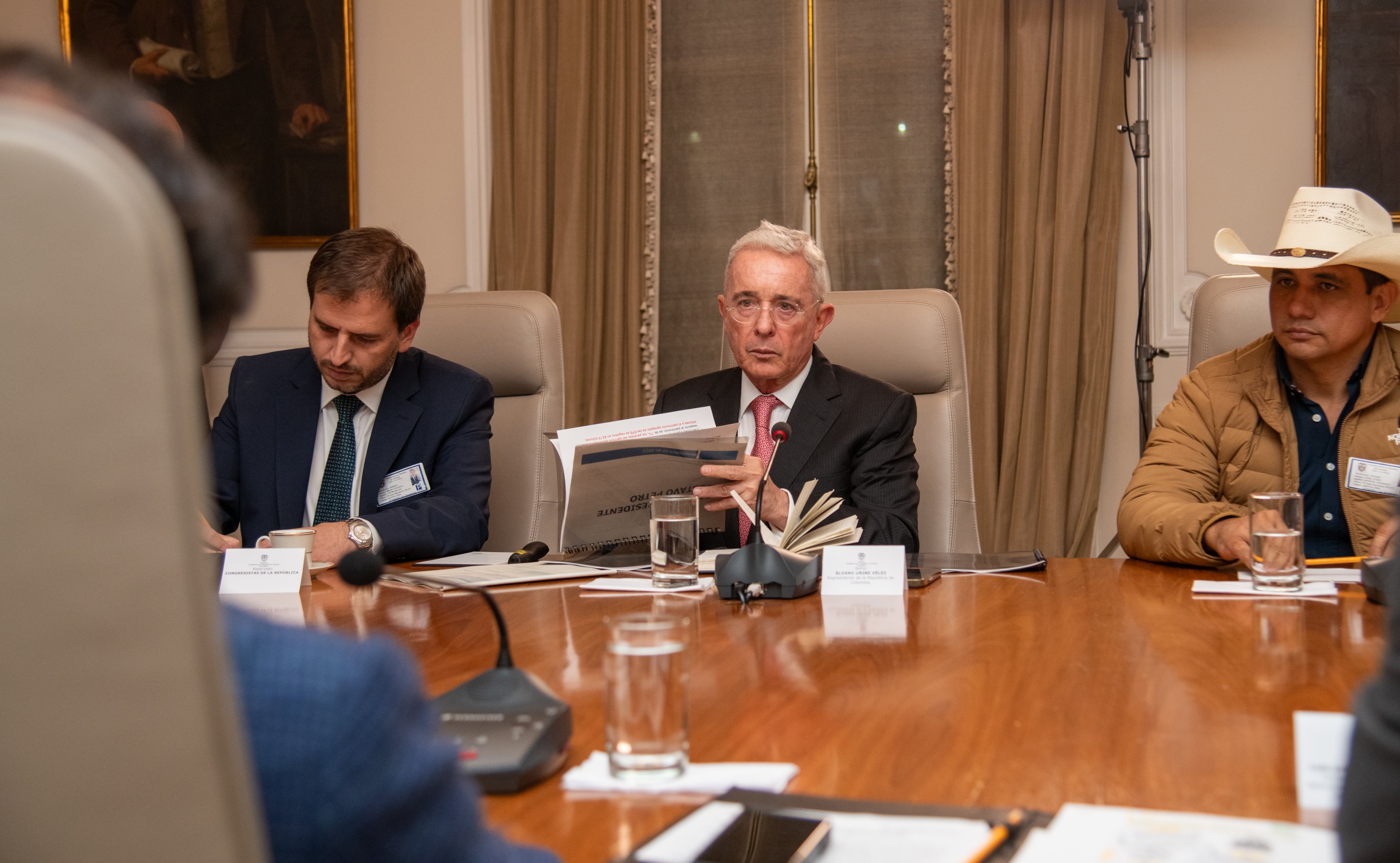
But as we move two steps forward, we made one major step backwards. At an event titled “Colombia, Democracy, and the Future of the Rule of Law,” the Neukom Center for the Rule of Law hosted Álvaro Uribe, the former President of Colombia. What was conveniently excluded from the conversation was that Uribe has been credibly linked to narcoterrorist Pablo Escobar and far-right paramilitary groups. A 1991 U.S. Defense Intelligence Agency (DIA) report identified then-Senator Uribe as a “close personal friend” of Pablo Escobar, and around this time, his brother, Santiago Uribe, used the family ranch as a launching point for his far-right paramilitary group, the 12 Apostles, to “systematically murder and exterminate people considered undesirable.” As President, Uribe’s administration oversaw the extrajudicial killings of 6,402 innocent civilians in cases known as “Falsos Positivos” (False Positives), where paramilitaries lured victims to a remote location, killed them, and dressed their corpses in guerrilla gear, implying that they were guilty.
While then-President Uribe denied knowing about the scheme, his “democratic security” policy, which he boasted about at the talk, offered financial and career incentives for these killings. After his Presidency, Uribe was convicted of bribery, witness tampering, and procedural fraud, but the ruling was overturned due to illegally obtained evidence.
The tradeoff between liberty and security is hard to get right. Uribe may not have been a perfect leader in a country checkered with corruption and violence, but he was effective in cracking down on drug cartels and guerrilla groups, as well as catalyzing private sector investments in his country. There’s a reason, after all, that he ended his term with approval ratings as high as 70%.
But what was missing from the conversation was that very tradeoff. Basic questions like, “How do you ensure that security reforms don’t jeopardize civil liberties?” or “How would you have handled cases like the ‘Falsos Positivos’ differently?” would’ve gone a long way towards getting Uribe to reflect on what Colombia gained and lost under his presidency. Instead, the moderator, Neukom Center Director Diego Zambrano, and co-panelist and former Colombian Senate member Paloma Valencia set aside these complexities to portray Uribe as the man who “saved Colombia” from democratic backsliding.
The double standards became unbearable when I asked Uribe why he believed the outgoing left-wing President, Gustavo Petro, was an existential threat to democracy. Both Professor Zambrano and Uribe eagerly cast aspersions about Petro’s guerrilla past and attempted to pass constitutional reforms and nationalize industries, but failed to look in the mirror. Moreover, Uribe and his supporters unsuccessfully amended the constitution so that he could run for a third term. The panelists suggested that the decision was made for the good of democracy, but in fact, it was a court that ruled the petition and amendment unconstitutional.
The day after the talk, I ran into Valencia and Uribe outside of Encina Hall. Now equipped with the information about his turbulent past and mixed record, I proceeded to ask him about each one of my concerns. For the most part, I found a leader who was eager and willing to engage with me on these hard issues. He explained how the DIA assessment got other parts of his background wrong, and deflected from knowing about his brother’s paramilitary group. Valencia was less interested in engaging with me and whisked Uribe away to their next meeting. Before leaving, Uribe shook my hand and said I should visit Colombia sometime.
Satisfied in the moment, I reflected on how lucky I was to have this conversation with Uribe. At the same time, I wondered why it had to fall on me running into the President of Colombia in between classes to challenge him privately, as opposed to the Neukom Center and its director asking challenging questions? After all, this is an organization committed to advancing “accountability, just laws, open government, and accessible justice.”
Beyond the Center itself, isn’t it the role of universities to lead students closer to the truth? The overwhelming impression of students at the event was adulation for the President and his vision for a safer, more stable Colombia. But with even a little bit of research, that impression becomes untenable, as we are left with more questions that were conveniently excluded from the talk.
South African President Cyril Ramaphosa’s talk earlier this week left a similar impression. One student called it a “politician’s speech, for better or worse.” But the critique shouldn’t be on the politicians. They will come with their pre-packaged talking points as long as death and taxes exist. Rather, it is the responsibility of students, faculty and organizations to create an institutional culture willing to push back.
Some might view it as hostile. Speakers may not want to come to Stanford anymore. But it is the fundamental role of universities to remain true to seeking the truth—not to cow to leaders. When we trade our principles for what is expedient, we stop being a university and start being a stage.