
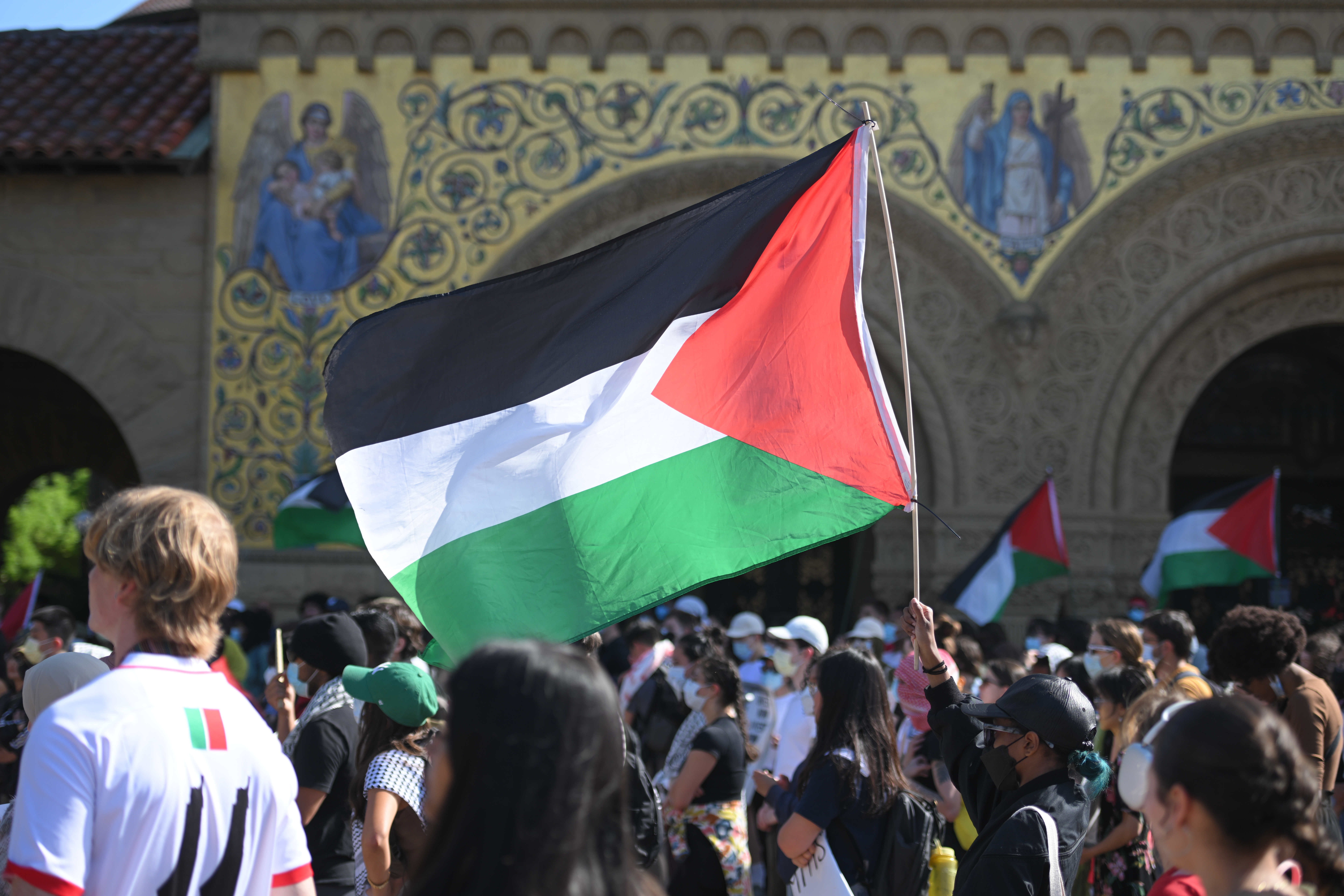
Last Monday, 13 of our peers began hunger striking for justice in Palestine. Today, as members of the Stanford Asian American Action Committee (SAAAC), we join them, taking our place alongside several dozens students in Northern California striking and demanding that our institutions end their complicity in unending horrors.
It has been over 500 days of genocide in Gaza, and more than 60,000 Palestinians have been massacred. It’s difficult to fathom, but Palestinians in Gaza are describing the unfolding conditions as the most unbearable and horrific yet: Israel has actively blocked food, water and humanitarian aid from entering Gaza for over 70 days now, starving the population within as food rots on trucks mere miles away.
Comprehending this violent reality, our peers have risked their health and wellbeing to force change where they can, demanding — by whatever means necessary — an end to Stanford’s investment in Israel’s genocide of the people in Gaza. Seeing our friends sacrificing their bodies has stirred our hearts and our minds; like them, we cannot bear to sit idly and observe as genocide unfolds. We’re not alone. Over the past 18 months, thousands of Stanford students, faculty and staff have called for Stanford to end its financial and institutional complicity in the genocide, only to be met with undemocratic deliberation and obstinate refusal to take steps towards change.
We escalate to a hunger strike because of Stanford’s continued silence despite our repeated calls for action. University president Jonathan Levin ’94 and Provost Jenny Martinez continue to ignore petitions, sit-ins, encampments and student voices calling for divestment; in fact, they now refuse to engage in conversation entirely. We turn, then, to that which they cannot ignore and that which is ours entirely. As our fellow hunger strikers have articulated: “When the university threads bureaucratic wire around our throats, we reach for the one instrument beyond its jurisdiction. The body speaks in a prose no committee can redline: it quivers, thins, goes ice‑cold after sunset. Each tremor mirrors, on a minute scale, the famine tightening its fist around Gaza.”
What can we do from the belly of the beast — from the technological center of the world’s single leading manufacturer of wars and bombs? This moment demands that we act upon our moral conscience — what does such conscience look like?
Throughout history, hunger strikes have served as a powerful form of non-violent resistance against imperialist oppression and state violence. Across the Asia-Pacific, our ancestors have turned to hunger strikes as acts which, by putting the body itself on the line, lay bare the brutality of colonial and militarized regimes. Mahatma Gandhi, the political leader of the Indian independence movement against British colonial rule, notably staged at least 17 hunger strikes during his lifetime.
As Asian Americans at Stanford whose displacement and survival in this country is the result of U.S.-led war and imperialist aggression in our homeland, we draw inspiration and strength from these histories and take up the mantle to fight back. This Asian American and Pasifika Heritage Month, solidarity means bringing our minds, bodies and spirits closer to the people of Gaza; by letting the oppressed masses of the world guide our hearts, we absorb the lessons of our history and locate our own humanity.
Stanford University should remember its own history, too: Stanford students have long employed hunger striking as a strategy to pressure administration into action.
In 1994, a hunger strike spearheaded by four Chicano/a students resulted in the creation of the Center for Comparative Studies in Race and Ethnicity (CCSRE) and its corresponding undergraduate program — a program whose history Stanford proudly boasts. And in 2007, a group of students and staff demanded a higher living wage by hunger striking for eight days, negotiating key changes to the University’s labor code of conduct and minimum wage.
Today, May 20, marks day nine of the hunger strike here at Stanford. Breaking from more democratic precedents set before them, President Levin and Provost Martinez refuse to even meet with the strikers, knowing full well that the strikers’ health conditions are rapidly deteriorating. In our meeting, we will demand the following:
- Full transparency and principled stewardship of Stanford’s endowment.
- That President Levin publicly call on Santa Clara County District Attorney Jeff Rosen to drop the unjust felony charges brought against the 12 Stanford students and alumni arrested during a June 2024 protest.
- That President Levin sign the American Association of Colleges and Universities’ open letter denouncing federal assaults on academic freedom and pledge Stanford’s noncompliance with any unlawful mandate alongside peer institutions such as Harvard.
- That Stanford University rescind its post‑encampment speech restrictions.
We remain steadfast because as students, we are compelled to act now. If the forced starvation of thousands of people in Gaza is not felt as a moral injury for University administrators, we hope that, at the very least, they will listen to the aching hunger of their students.
These University leaders who claim to respond to students’ needs have hid their faces to shield themselves from critical accountability. We have no desire to eat from the hand of a University complicit in one of the worst human atrocities of our lifetimes.
We call on our Asian American community and the entire student body to send letters demanding that Stanford administrators meet and negotiate with the hunger strikers, as well as sign the petition to drop the felony charges against the 12 Stanford students who bravely protested against genocide last June. If you yourself have felt your heart ache for the manufactured famine in Gaza and/or the unwavering strength of your peers, please consider volunteering as a hunger striker yourself or providing support to strikers.
President Levin and Provost Martinez, we hope to see you in White Plaza.
Vivian Ha ‘26 is a student at Stanford and member of Stanford Asian American Action Committee (SAAAC). They are the primary author of this article on behalf of SAAAC.