
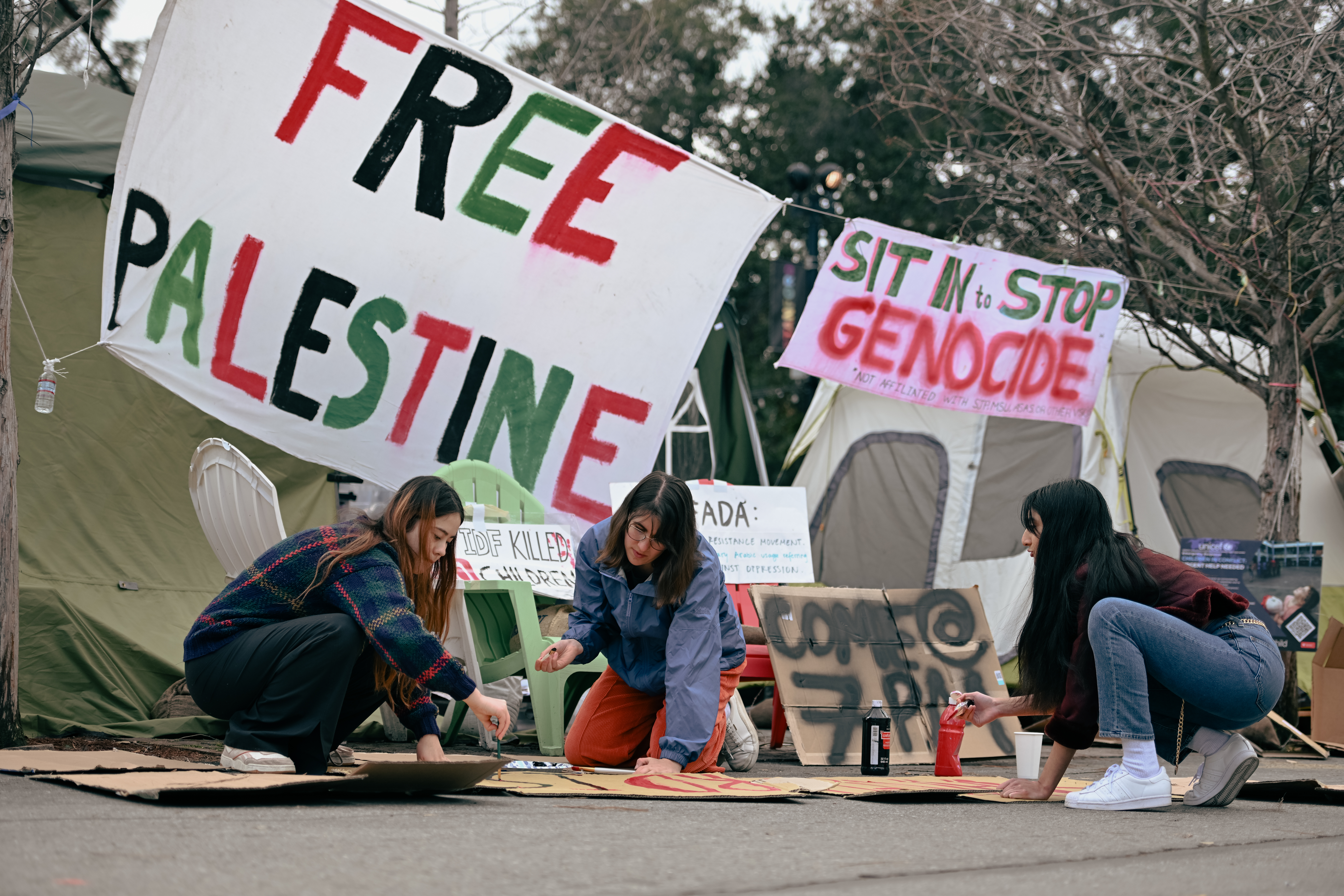
At a Stanford event a few months ago, University president Jon Levin ’94 and Hoover Institute Director and former Secretary of State Condoleezza Rice discussed the challenges facing American universities as they navigate an “era of misinformation.” When asked about pro-Palestinian demonstrations on campus, Dr. Rice responded by saying, “I just wanted to ask [the protesters], from which river to which sea?” She was apparently “appalled” at the students’ lack of understanding of the Middle East and stressed the importance of “being informed” about protesting.
On its surface, this might sound like an appeal to intellectual rigor — a reminder that universities should be places of knowledge, nuance and inquiry. But in context, Rice’s remark was something else entirely: a thinly veiled act of condescension toward pro-Palestinian students, and by extension, toward anyone who dares to express outrage at Israel’s ongoing atrocities in Palestine. And, unfortunately, this view is not isolated to Dr. Rice; one can argue that the University’s overall approach these last two years towards pro-Palestinian voices has been equally dismissive and disdainful. (It’s no coincidence that she shared the stage with the current University president when making these comments.)
When powerful figures like Rice tell student protesters to “be informed,” they are not encouraging dialogue. They are dismissing it. The implication is clear: that these students don’t know what they’re talking about, that their convictions are naïve or misinformed, that their moral clarity is rooted in ignorance rather than reason. It’s a way of sidestepping the substance of their claims — claims about collective punishment, apartheid and the mass killing of civilians — by reducing them to an intellectual deficit.
But these students are not uninformed — they know it’s the Jordan River and the Mediterranean Sea. I’m genuinely curious if Dr. Rice actually engaged with these students, or if she simply assumed their lack of knowledge.
They have seen, as we all have, the images, videos and reports that have emerged — and are still emerging — from Gaza: flattened neighborhoods, emaciated bodies, hospitals bombed, prisoners raped and children slaughtered, burned alive or pulled from rubble. They have read the investigations from Human Rights Watch, Amnesty International, B’Tselem, the International Association of Genocide Scholars and independent U.N. experts — bodies that have definitively characterized Israel’s actions as genocide and crimes against humanity. They have listened to Palestinian voices who have endured decades of occupation, blockade and statelessness.
If anything, it is the refusal to confront this mounting evidence that signals a lack of information — or worse, a lack of empathy.
Rice’s condescension also carries a deeper irony. As a former top U.S. diplomat and national security official, she helped preside over wars in Iraq and Afghanistan that were justified through gross misinformation — wars that cost hundreds of thousands if not millions of lives and destabilized entire regions. Not to be outdone, she also played her role well in Palestine: after Hamas won a plurality of votes in the 2006 parliamentary elections, she helped engineer an unsuccessful coup by Fatah (the losing party), ignited a violent civil war between the two, sequestered the Hamas government in Gaza and greenlit the Israeli-led blockade of the Strip thereafter. Ultimately, millions of Palestinians have suffered over the past 18 years thanks to her leadership.
For her now to lecture young people about the importance of “being informed” is not just hypocritical; it’s insulting. These students are doing precisely what universities should encourage: questioning power, demanding accountability and refusing to accept official narratives at face value.
Over the last two years, Stanford has noticeably focused quite a bit on fostering open-mindedness, curiosity and civil discourse on campus. But those values mean very little when they apply only to certain kinds of speech. True intellectual humility requires listening to those with whom you disagree — not belittling them for daring to challenge entrenched power.
And the opinions being expressed by these students — that Palestinians deserve freedom, safety and dignity — are no longer a fringe view, and we should stop pretending as such. A slew of recent national polls underscores this point: in September, a New York Times/Siena poll found that, for the first time, more Americans sympathize with Palestinians than with Israelis. A Pew Research poll found that 59% of Americans hold an unfavorable view of Israel. A Quinnipiac poll found that 50% of Americans believe Israel has committed genocide, and 60% oppose sending it more military aid.
So is the American public now “uninformed,” too? Are human rights organizations around the world misled? Or are these student protesters simply saying something that makes Condoleezza Rice uncomfortable?
There’s a deeper reason why Dr. Rice’s comment stings. It reflects a long tradition of dismissing Palestinian pain as something that must be “explained” rather than felt. Palestinians are told their suffering is too complicated to condemn outright, their demands too simplistic, their slogans too provocative. But the reality is simple: a people under siege, deprived of basic rights, are crying out for freedom. And young people of all backgrounds are standing in solidarity with them. That deserves respect, not ridicule.
If Stanford truly wants to model civil discourse, it should start by treating all moral and political positions with equal seriousness — including those that criticize the Israeli government. Professors and administrators should engage students’ arguments on their merits, not question their intelligence or motives.
No slogan, including “from the river to the sea,” should be off limits to honest debate. Words like “intifada” should not be treated as verboten; even if they offend certain sensibilities, we should not resort to censorship to settle arguments. Honest debate requires good faith, and good faith begins with assuming that one’s interlocutor has thought deeply and cares sincerely. It means asking “What do you mean?” rather than “Do you even know what you’re saying?”
The students protesting for Palestine are not ignorant. They are informed, impassioned and morally awake. They are doing what education at its best inspires: linking knowledge to conscience, and conscience to action.
So let’s stop patronizing them. Let’s start listening.
Firas Abuzaid ’13 M.S. ’15 Ph.D ‘22 is the president of the Stanford Palestinian Alumni Association. He previously served on the Stanford Muslim, Arab and Palestinian Communities Committee.