
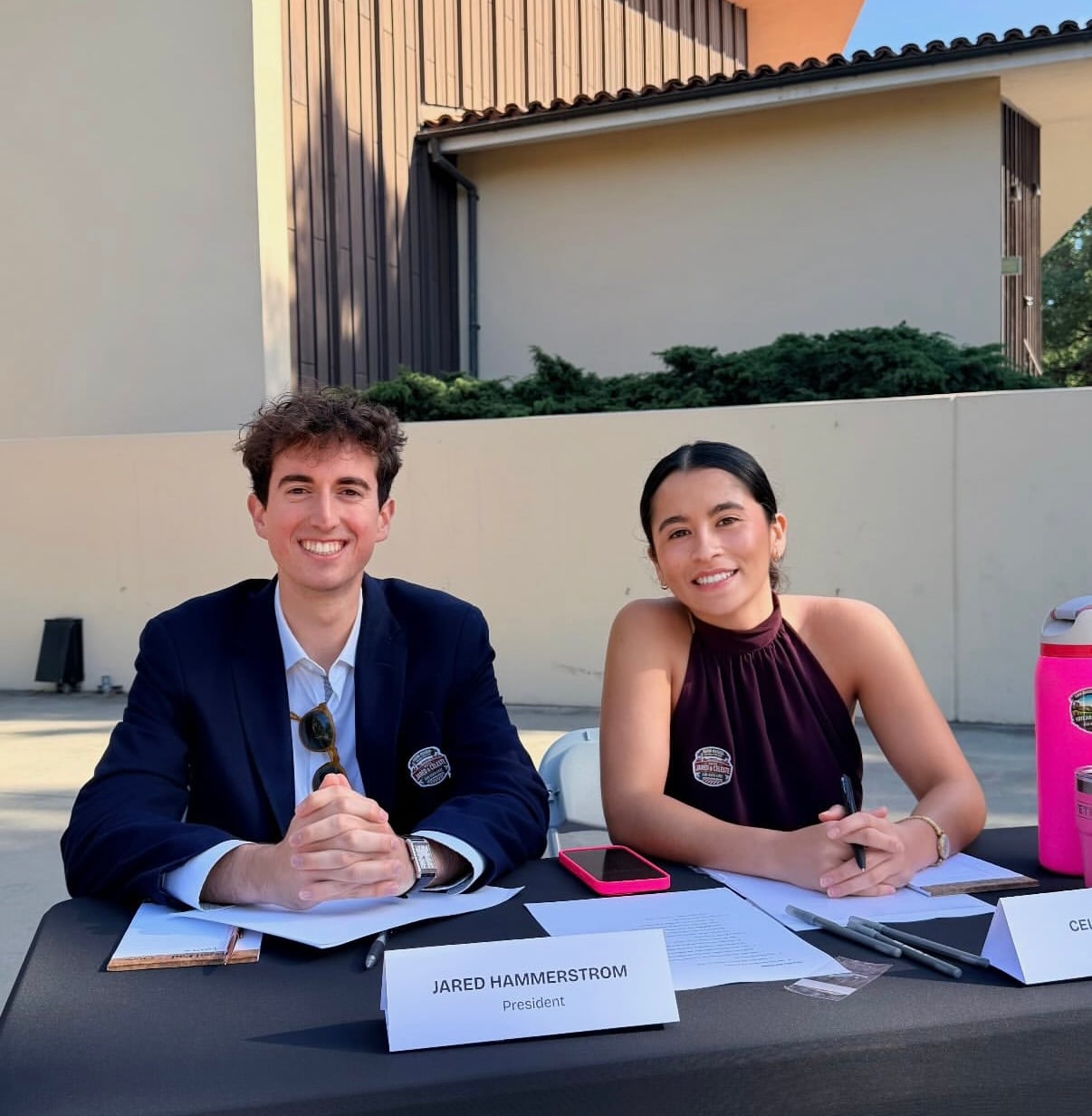
Jared Hammerstrom ’27 and Celeste Vargas ’27 were elected the next president and vice president of the Associated Students of Stanford University (ASSU) after defeating two opposing slates two weeks ago. The pair, who ran under the “FARM RAISED” slate campaigned on a platform rooted in their two years of experience in the Undergraduate Senate (UGS).
Hammerstrom and Vargas sat down with The Daily for an interview to lay out their aspirations before they assume their roles in May.
“I’m very grateful to have been elected to this role,” Hammerstrom said. “It will be my privilege to serve each and every member of the Stanford community.”
Hammerstrom is a junior from Atlanta, Ga., studying international relations and economics, and serves as a member of the varsity fencing team. For him, the win comes after two years on the UGS, including serving as chair of the Administration and Rules Committee and treasurer.
Vargas is a junior from Turlock, Calif., studying political science and currently chairs the UGS Appropriations Committee, where she oversees the allocation of roughly $6 million in voluntary student organization (VSO) funding. Vargas also served on UGS for two years previously.
“I am very excited to step into this vice president executive role alongside Jared, who is someone I’ve worked with for the past coming on three years,” Vargas said.
Both emphasized their intent to build a broad coalition once in office.
“I would say that in all the communities and spaces on campus and off campus that I’ve been part of, the thing that makes the greatest difference is the team,” Hammerstrom said. “I want to get a great, passionate group of people from all different niches at Stanford to get together and to serve the needs of the student body.”
Vargas echoed that vision. “I’m really excited to bring a group of people who come from different pockets on campus, both undergraduate and graduate students, to leave Stanford better than we each found it,” she said.
The “FARM RAISED” slate received 1255 votes after the fifth and final round of voting, prevailing over the “BUILT DIFFERENT” slate of Jake Hofman ’27 and second-year Ph.D. student Angikar Ghosal and the “No Brakes” slate of Madhav Prakash ’27 and Eva Lacy ’27. “BUILT DIFFERENT” and “No Brakes” received 967 votes and 690 votes in the initial round of voting, respectively. Hammerstrom and Vargas’ campaign drew heavily on their senate experience, arguing that it uniquely prepared them for the executive roles.
“I’ve known Jared since freshman year and am so proud of all he has accomplished thus far,” wrote Annika Kaval ’27 in a statement to The Daily. “I’m so excited to see all the great things he and Celeste will achieve as ASSU executives.”
Free speech emerged as a defining issue across all three campaigns, and Hammerstrom and Vargas indicated it will remain a top priority. The pair has criticized the University’s free speech policies, announced in September 2024, that relegate protests to White Plaza and limit amplified sound above 60 decibels to a single hour each weekday. Hamerstrom previously called these restrictions “absurd.”
“Jared and I both believe that free speech is integral to a college campus and college student’s experience,” Vargas said. “We believe all students should be able to freely express their views without fear of doxxing, or without facing unnecessary institutional barriers.”
Their plans include working with administrators to expand the current noise window in White Plaza and raise the permitted decibel level, alongside protest workshops to better inform students of their rights and University policy. Hammerstrom said he hopes to position the executive office as a mediator, rather than an adversary, to administrators.
“When it comes to free speech, I hope to bring the conversation between administrators and students together to achieve the shared goal of student safety and protecting First Amendment rights,” he said.
The pair is also turning their attention to sexual violence prevention, an issue that has gained urgency in recent weeks after a a jogger last month reported that an armed man sexually assaulted her near Mayfield Avenue and Santa Ynez Street, prompting campus-wide concern and a Clery Act alert from the Stanford University Department of Public Safety (SUDPS).
On Wednesday, the UGS unanimously passed a bill calling for the reinstatement of Beyond Sex Ed (BSE) as a mandatory New Student Orientation (NSO) program after the University announced it would become optional next year.
“Our executive team takes sexual violence prevention and sexual education very seriously,” Vargas said. “We want to beckon a culture of safety when it comes to discussing sexual violence. And we believe the best way to do this is through education.”
Vargas plans to work with the SHARE Office to pilot a four-year sexual education program designed to be interactive for students. This would expand education programming beyond the NSO model that has been standard for the past decade.
At the UGS meeting this Wednesday, UGS Chair David Sengthay ’26 pushed for BSE’s reinstatement, citing the “red zone” — the first 90 days of college for freshmen, during which students are statistically most likely to experience sexual assault on a college campus.
Hammerstrom said the executive office would also push for greater transparency from the University “when it comes to sexual assault on campus.” “Celeste and I will do everything possible to foster a safe environment on campus for students,” he said.
Social life — a key issue during the election and a long-standing flashpoint in Stanford’s campus discourse — was central to FARM RAISED’s platform, which named traditions like Full Moon on the Quad, Flicks, Day N Mayfield and Crochella as priorities for sustained funding. The slate also pledged to support Row events, Cardinal Nights ticket subsidies and bi-weekly social programming.
“Social life at Stanford is integral to the student experience,” Hammerstrom said. “Being able to foster this collaborative, not competitive, environment is what I want to cultivate… and Celeste and I have the relationships with administrators to bring those creative Stanford ideas to life.”
Writing to The Daily, Vargas framed the social mission in personal terms.
“Through social life, my goal is simple: make sure every student feels what I feel here every day,” she wrote. “That sense of possibility, of community, of us. We are Stanford. Looking forward to a fun year ahead!”
Both Hammerstrom and Vargas said they measure success by providing for the student body. “I will walk away proud of the work that I did in this role if I make even a small difference in the Stanford student experience,” Hammerstrom said.