
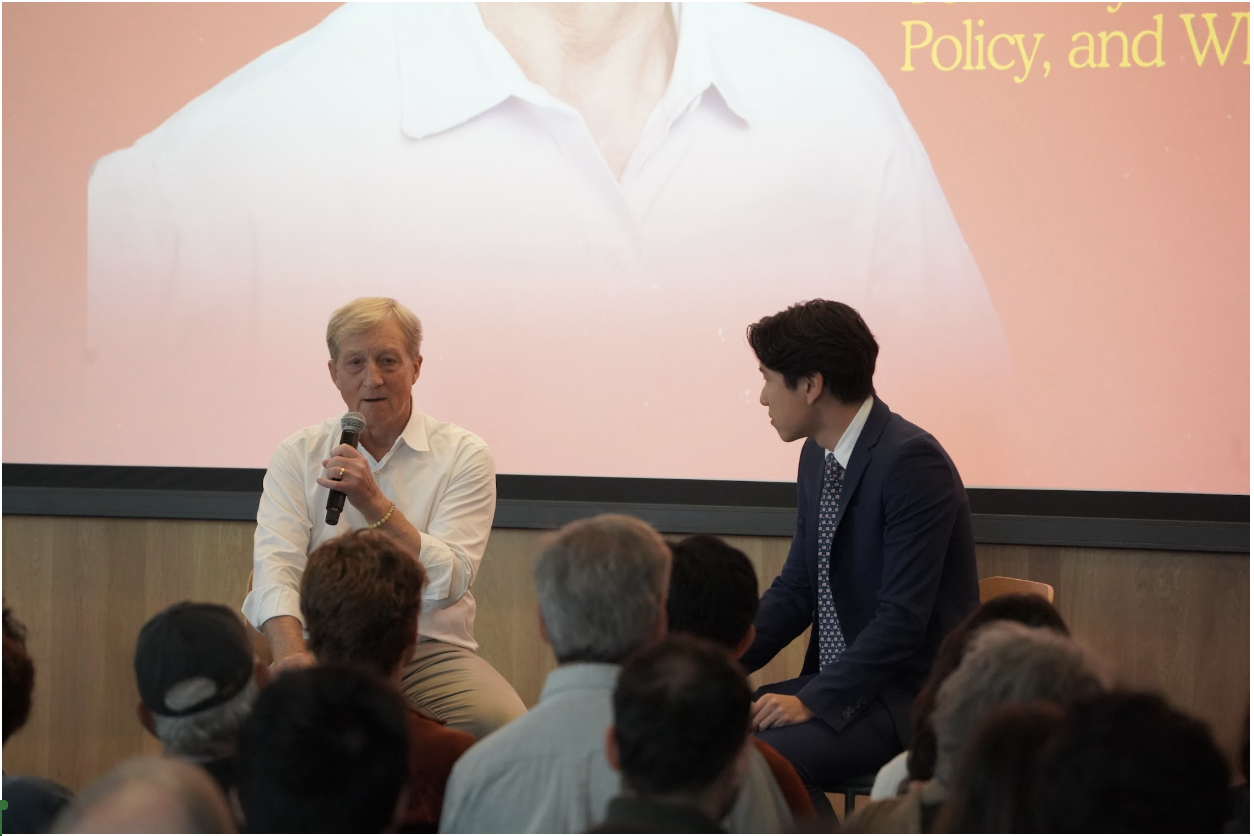
Tom Steyer MBA ’83 had a simple message while speaking at a Stanford Climate Week event on Thursday: clean energy is already winning, whether or not Washington helps.
Now in its third year, the student organizers of Climate Week expanded programming beyond science, with sessions on climate and the arts, law, tech and the government.
Steyer, who placed third in the California gubernatorial primary, returned to campus two weeks after speaking at a Stanford in Government event.
“So can we win without policy? We are winning without policy,” he said to over 150 students, professors and industry leaders at the Simonyi Conference Center.
The former presidential and gubernatorial candidate pointed to cost as the defining factor. Solar and wind prices have fallen sharply, and battery costs specifically have dropped roughly 90% in the last decade, Steyer said. Rising oil prices are pushing households towards heat pumps. Steyer noted that Europe and Asia are already moving off fossil fuels for economic reasons.
Steyer argued that this cost advantage makes climate less a partisan fight than a competition between countries. Global powers have been built on energy: Great Britain on coal, the U.S. on oil and now China’s heavy investment in renewables.
“If we decide that we’re going to go with 20th century energy, we will definitely lose,” he said.
Steyer argued that the slow shift to green energy in the U.S. is a product of politics, not economics. He noted that the U.S. government heavily subsidizes fossil fuels, even as Europe and Asia move towards green energy. The result, Steyer said, is an American public that carries the cost.
“No one is paying for climate change except for you,” he said. “Everyone else is paying for climate change except for the people causing climate change, making four times as much money.”
Steyer’s solution? Carbon pricing that forces polluters to pay a fee, along with carbon border adjustments that charge a toll on imported goods based on carbon dioxide emissions. In his view, policy dictates how fast the shift happens, not whether it happens at all.
“We should not rely on people to do things against their self-interest because they’re nice. We should make sure that it’s in their self-interest to do what is nice,” he said.
Steyer said Stanford is where much of this green energy infrastructure gets built. He pointed to the TomKat Center for Sustainable Energy, which he and his wife Kat Taylor J.D., MBA ’86, founded with a $40 million gift in 2009. The center funds sustainable energy research and gives grants to help students and researchers turn their ideas into startups. Steyer called it a good investment for both the university and the companies it has supported.
Great research universities magnify their impact by commercializing it, he said, a tradition he traced back to as early as Bill Hewlett ’34 and David Packard ’34.
“You have to be a great school, where people are doing excellent groundbreaking research, and going back to their dorm room at night, and thinking, ‘Could this be really worth it?’” he said.
The keynote event was moderated by Robert Liu ’28 and Eshaan Kothari ’28.
For Kothari, who studies energy engineering, Steyer’s experience is what made him the right speaker. The energy transition will take real strides, he said, and Steyer’s talk left him more hopeful than he expected.
“It’s easier as you get older to become cynical,” Kothari said, “but he makes me feel so much more optimistic.”
Hoyoon Song ’28, who initially reached out to Steyer on behalf of Stanford Climate Week’s organizing team, shared a similar sentiment. He said he “enjoyed hearing how Steyer reframes such complex issues into something that is much more collective.”