
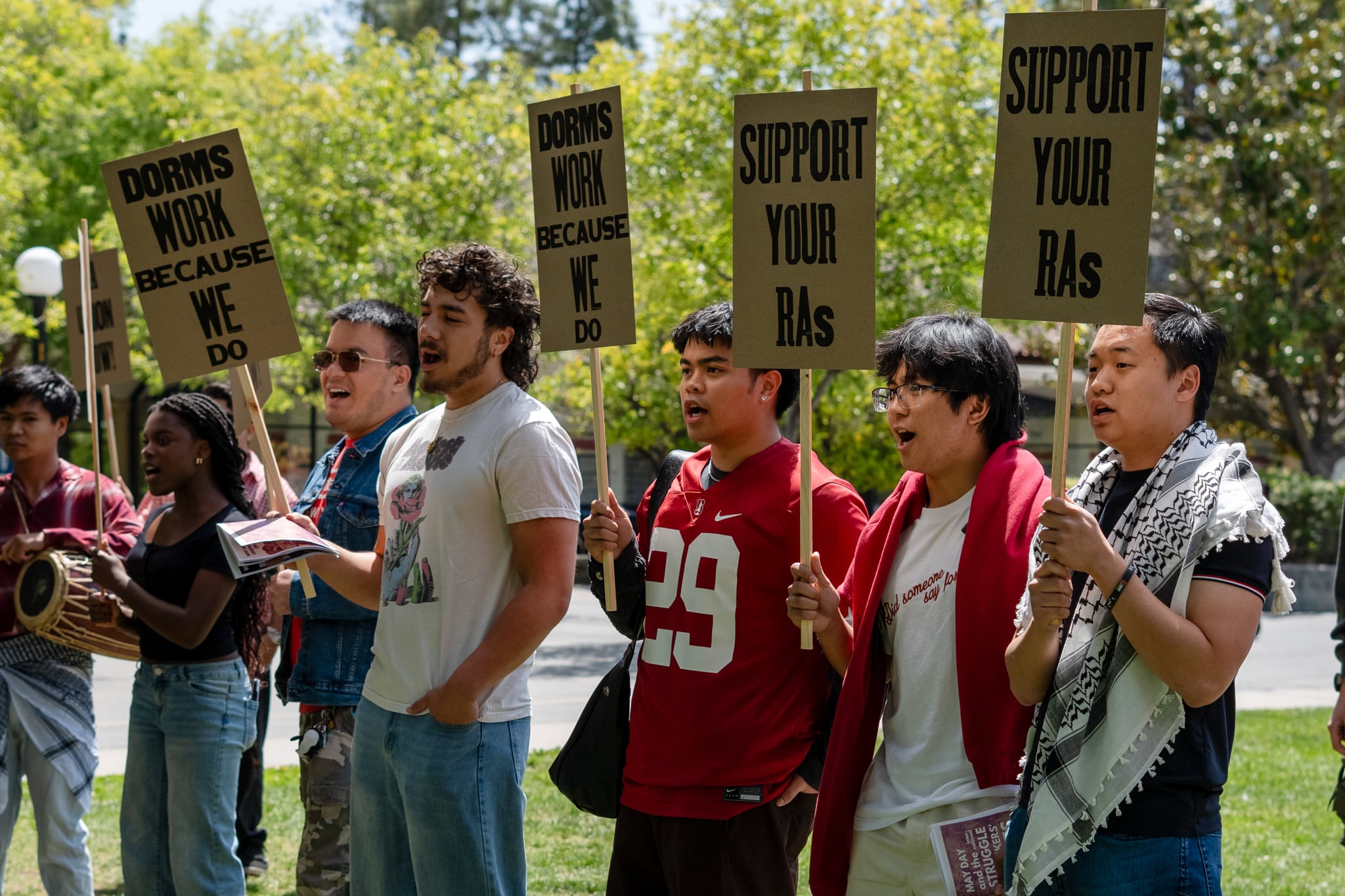
Over one hundred Resident Assistants (RAs) and students gathered Friday for a card-signing rally to support recent unionization efforts, which cited overwhelming staff shortages and underpayment.
Rally-goers heard personal stories from current RAs, picketed around White Plaza and collected more signatures for union authorization cards at a nearby table. Attendees also participated in a series of chants, voicing their demands for better treatment.
Shuci Zhang ’27, one of the rally’s organizers and RA at Terra House, celebrated the group’s unionization efforts, which remained undercover throughout the academic year until the announcement in late April.
“This rally is the culmination of a year of hard yet incredibly rewarding organizing work,” she wrote to The Daily.
According to Zhang, the rally was strategically held on May Day, an internationally recognized holiday honoring workers’ rights and labor movements that saw protests from workers and community organizers across the country.
“We picked May Day to launch to emphasize our role as essential workers,” she wrote.
Jenny Ballutay ‘28, who helped organize the event and a humor editor for The Daily, could be heard chanting alongside dozens of RAs and students. Her voice echoed through the plaza as rally-goers repeated her chants.
“What’s disgusting? Understaffing! What’s outrageous? They don’t pay us!” they chanted.
“Hey Hey! Ho Ho! Understaffing has got to go!” Ballutay continued.
Attendees held picket signs that read “RAs R Workers” and “Support Your RAs. Several RAs spoke about their experiences of underpayment and working in understaffed dorms.
Student organizers for the unionization noted that the University has not reached out to them since they publicized their signature effort.
In a statement to The Daily, University spokesperson Angie Davis acknowledged the ongoing unionization efforts — the first public acknowledgement from the University.
“We are aware of the signature effort,” she wrote. “We value the role of residential student leaders in supporting residential life at Stanford and are committed to a strong and fulfilling experience on campus for all of our students.”
Jared Hammerstorm ’27 and Celsete Vargas ’27, the incoming ASSU Executive President and Vice President, affirmed the students’ push to unionize.
“We support the right of students to organize,” they wrote to The Daily. “We believe it is essential that this process remain grounded in collaboration with the administration with a shared commitment to strengthening the residential experience for both students and residential assistants.
At one point during the rally, Lisa Oldham ’91, a former RA who was on campus for the Black Alumni Summit this past week, jumped on the megaphone to express her support for the unionization efforts.
“We were there for our students when parents and faculty were not,” she said. “I’m proud of you…keep fighting.”
Dawn Royster ’26, a Branner Hall RA and one of the rally’s speakers, described being exhausted and overwhelmed in an understaffed freshman dorm after two RAs were fired at the start of the academic year. Royster is a contributing writer for The Daily.
“Freshman RAs play an important role at Stanford to build culture and community,” she said. For her, the understaffing proves “the University [admin] does not feel injustice.”
Jesse Judah-Bram ’27, one of the union co-organizers and a current RA for Mirlo in West Florence Moore Hall (West FloMo), noted that RAs exist to sustain community, but are often overwhelmed.
“We are not just there to talk to residents…we are locksmiths, we are cooks, we are party planners, we are counselors. We do all these roles,” he said.
Many RAs who are supporting the unionization efforts reported working additional jobs on top of being an RA in order to cover tuition costs, including Victoria Tuffour ’26, an RA at Rinconada (Rinc), who works two additional jobs.
“Myself and the other RAs have had to take on additional duties, additional time with on calls, emotional support…I think having a union will ensure that we have the rights [to] not be overworked,” she said.
While Stanford RAs receive a $12,400 stipend, the yearly cost of room and board at Stanford starts at $21,035. In contrast, at the University of California, Berkeley, RAs receive both room and board and a student meal plan. At the University of Pennsylvania, where RAs successfully formed a union, RAs receive housing, 150 meals and a $3,000 annual stipend.
Undergraduate Senate (UGS) Chair David Sengthay ’26 highlighted the impacts of Stanford’s compensation model on first-generation and low-income (FLI) students.
“RA compensation that excludes room and board imposes a financial burden that disproportionately affects FLI students, who are most likely to take on residential leadership while carrying the most financial pressure,” he wrote to The Daily.
Many RAs present at the rally felt unionizing was necessary to address the problems they are facing.
“Generally speaking, they don’t listen unless they feel pressure,” Zhang wrote, referring to Stanford’s administration. “I can speak from my own personal experience that, in Terra’s case, our emails about filling the vacancy did not receive a response until the ‘march on the boss’ action.”
Angel De Dios López ’26, an RA at Otero, felt compelled to join the union because they felt undervalued by the university.
“Many of us are not seen as valuable community members. From folks working within the university to RAs, we’ve struggled to feel worthy to the university,” De Dios López said. “I believe that we, the RAs, should have a voice. A voice to stand up for ourselves…that voice comes through becoming a union.”
Amanda Campos ’26, an RA at Potter, said that for her, unionizing is about having a voice in conversations that impact residents.
“For example, during a mental health crisis that I and many others were helping manage, the residential director chose to send [a] police officer which worsened the situation,” she said, “As an RA, I would like to have a voice and shape their response in supporting residents.”
Trin Nobles ’27, another RA in Rinc, an understaffed freshman dorm, felt removed from the decision-making process for RA firings and hoped a union could push for improved communication from the University administration.
“Decisions are being made without dialogue without the people who are doing this job. I find myself constantly worried that something I may do can put my position at risk,” they said. “Two RAs may do the same thing, or break the same rule, but if they have different Residential Directors (RD), consequences are extremely varied.”
On Wednesday of last week, (UGS) unanimously voted on a resolution in support of RA unionization efforts. In a campus-wide email sent last Thursday, Sengthay encouraged students to attend the cardsigning rally.
“If you have ever had an RA who made a difficult moment a little more bearable — or who simply made a dorm feel like a home…show up for them,” he wrote in the email.