
Brianna Booth, PhD, served as the first Director of Positive Sexuality at Stanford from 2016-2026. Her work has been guided by the belief that we can build a more intimate world.
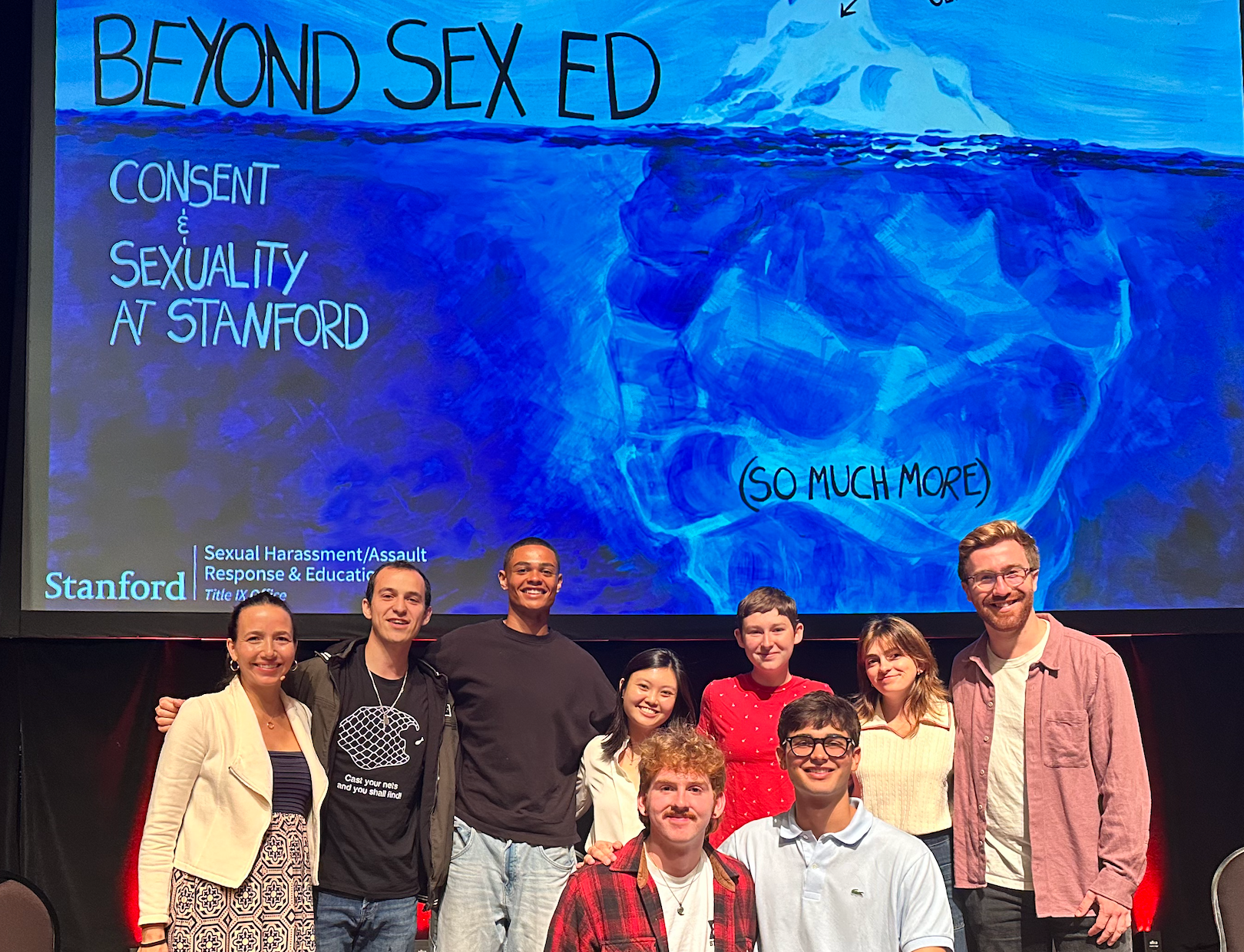
For the past 10 years, I have led Beyond Sex Ed (BSE) as a required part of New Student Orientation. University administration chose to discontinue it this year. With its abrupt end, I want to explain why BSE was an essential part of a Stanford education and an innovation in maturing a stunted area of our collective development.
BSE created the context for students to develop themselves as ethical human beings capable of healthy, respectful and flourishing relationships, with relevance not only for their future impact on the world, but for the quality of campus life they create.
The purpose of BSE was simple: to practice talking about human sexuality in a thoughtful, honest way, and to do so inside a community of people with different backgrounds, worldviews and experiences.
The alternative is to do what we’ve always done, which is to keep sexuality in the shadows. When sexuality is not integrated with the rest of life, it becomes the proverbial monster under the bed that subconsciously shapes not only our lives but the world, and campus, we live in.
We become pushy and aggressive because we weren’t taught how to hold and communicate our desire. We make careless comments because we were trained to use humor to deflect discomfort. We rely on alcohol or other substances to push past embarrassment and shame. We treat people like objects to avoid the vulnerability of true intimacy. We perform a role we’ve seen in porn or Hollywood instead of being our authentic selves. We let our sexuality go dormant because of disappointing experiences. We bury our painful stories, burdening us and our relationships.
In short, we hurt other people. We hurt ourselves. Unhealed pain gets passed onto our children, and the cycle continues.
Learning to talk about sexuality, though, brings it out of the shadows — a necessary step if we ever hope to develop skill, morality and values to live by.
BSE recognized the need to address campus sexual assault systemically, holistically and seriously. Risk factors for sexual violence are well documented: peer groups that reward bad behavior, adversarial relationships between men and women, cynical or superficial attitudes toward sex, hostile masculinity and a basic lack of skill in intimacy and empathy.
To counter these risk factors, we created a place for character development among peers, to practice empathy and honest connection, and to witness models of healthy masculinity and meaningful representations of sex.
It’s worth noting that the points above are essential not only to prevent sexual violence, but for anyone and everyone to have healthy friendships and happy marriages, to become attuned parents and build strong families, and to be engaged citizens and effective leaders.
At Stanford, BSE was a solution in action. I asked the audience hard questions, both about why we treat people the way we do and how to follow our own internal guidance system. I believed, and still believe, that if we treat sexuality with enough reverence and share our stories with enough vulnerability, we will see our common humanity and have more compassion for ourselves and others.
Every spring, I taught a class called StoryCraft: Sexuality, Intimacy & Relationships. Sixteen students sat on the floor with no desks, chairs, laptops or notebooks. My TAs and I would tell our stories before starting the process of asking questions and eliciting their stories.
What did you learn in sex ed? What do you wish you’d learned? What’s an experience of heartbreak you’ve had? Have you ever had a crush on a friend? What’s your experience of saying “I love you”? Do you want to get married?
Students told their stories again and again without ever writing them down, slowly discovering the throughline. The painful parts got digested, and what they were once afraid to talk about became a source of strength.
Their stories spanned the pain of a breakup, feeling “behind,” positive firsts, commitments to abstinence, struggles with pornography, coming out, finding friends, experiences of hookup culture, healing after sexual assault and falling in love.
In the fall, seven of these students would sit in a semi-circle behind a center spotlight in Memorial Auditorium. One by one, they stood at the mic with their arms at their sides, holding no notes, behind no podium, telling their story to nearly 2,000 new students. Sitting on the side of the stage, I could have heard a pin drop.
We pulled back the curtain to reveal real life, thereby dispelling assumptions about college and giving students an opportunity to consciously choose a deeper set of values to guide their lives.
Thousands of students have expressed their gratitude for those storytellers. They couldn’t believe the courage it took to share such personal stories with strangers. They were grateful to know they weren’t alone in their struggles or their desire for more depth, more meaning and truer relationships. They remarked on the stories’ diversity and their surprise at how easy it was to relate to each one in some small way. They’d exclaim that this was unlike any sex ed they’d received and that they couldn’t believe they were at an institution that valued this conversation.
From 773 students who attended BSE in 2025, 93% felt hopeful about the community they were building, 86% felt more curious to know their own and others’ yeses and nos, 88% felt able to express themselves in their conversation circle debrief, 90% reported gaining more empathy for others and 87% felt more acceptance of themselves, their values and their own timing with regard to sex and relationships.
Beyond Sex Ed was yet another area where Stanford offered an innovative solution to a problem that has challenged societies for millennia. As the program comes to a close, and as our world gets more complex, here’s what I hope can guide us moving forward.
Sexuality is one of the most vibrant and vulnerable parts of being human. It touches us at our core. That’s why it means so much to us, why our feelings are so intense, why violations hurt so much and why it takes so much courage to tell our story.
Stories are essential. As the philosopher Alasdair MacIntyre argued, we cannot understand human virtues without understanding human stories. Through stories, we learn to recognize what bravery looks like, the impact of betrayal on a relationship and what happens when a person lacks integrity.
When we learn to talk about sex, we learn the skills to talk about all sorts of hard topics. When we can talk about hard topics, we have better relationships, which are the key to a happy life.
We live in a culture of comparison, exacerbated by social media, porn, dating apps and hookup culture. It’s easy to get caught up in the hollowness of external validation, so it is crucial that you stay with yourself, your values and your internal guidance system.
Consent is the law, but attunement is the skill that actually allows us to connect. None of us ever masters this skill, but we can all get better at it. So, practice. Slow down. Pay attention. Be curious. Ask questions.
As our world becomes increasingly inundated with AI, I think and hope that you will crave what is real. Remember what it is to be human, and that being human is messy, unscripted, imperfect, full of mistakes and magnificent. Remember also, we are always presented with the opportunity to repair, to grow and to find deeper meaning. Partnership comes with all this complexity, and it is profoundly worth the effort to find and build.
Societies around the world struggle with sexuality. It is remarkable that we were ever able to have such a conversation. An endeavor like this is risky, delicate and requires an enormous amount of care to invite everyone into conversation. Has this ever been done — at this scale, with this diverse of a community and with this much civility? Not that I’m aware of.
That’s something I believe Stanford should be proud of.